
Application
Airway tubes
ZwiGuard™ is a drug-free coating tested for mucus flow and bacterial adhesion on silicone, with no endotracheal tube study published yet.
- Devices
- Endotracheal tubes, tracheostomy tubes
- Substrates
- silicone (published); others measured in the feasibility round
- Thickness
- tunable, from a few micrometres to 100 micrometres or more (ZwiCoat process range); about 7 micrometres in the published silicone work (Leigh 2019)
- Sterilization
- validated on your cycle during joint development
- Regulatory path
- 510(k); our Master File supports the filing
- Evidence
- mucus-flow bench model on silicone tubes; rats, 21 days (bacteria); cadaveric cochleae (insertion force); no airway-tube study published
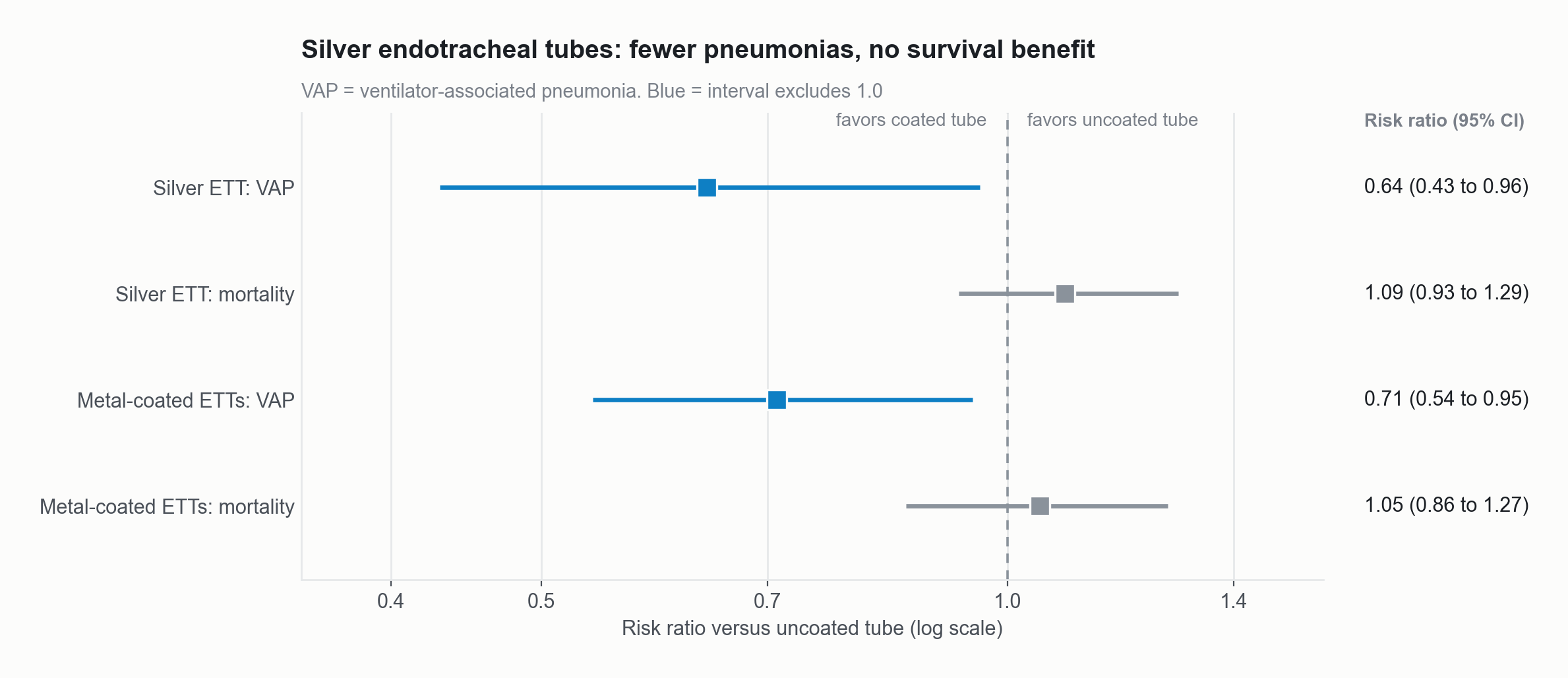
Silver and metal-coated endotracheal tubes lowered ventilator-associated pneumonia but did not change hospital mortality.
Source: Tokmaji G, Vermeulen H, Muller MC, Kwakman PH, Schultz MJ, Zaat SA. Silver-coated endotracheal tubes for prevention of ventilator-associated pneumonia in critically ill patients. Cochrane Database Syst Rev 2015;(8):CD009201 (silver ETT, 1 RCT, 1,509 participants); Yang Y, Xiong X, Wang X, Dong Q, Pan L. Prevention of ventilator-associated pneumonia by metal-coated endotracheal tubes: a meta-analysis. Crit Care 2024;28(1):309 (5 RCTs, 2,157 patients)
The problem
Reported figures show how much a breathing tube asks of the airway. In a review of nine studies, 83 percent of intubated ICU adults had laryngeal injury (Brodsky 2018). In one prospective ICU study, biofilm was found on 95 percent of endotracheal tubes (Gil-Perotin 2012). Each ventilator-associated pneumonia costs about $40,000 (Zimlichman 2013). In children under 5 in intensive care, each extra five days of intubation raised the risk of subglottic stenosis about 50 percent (Manica 2013).
Silver-coated tubes address infection only. In a Cochrane review they lowered ventilator-associated pneumonia (risk ratio 0.64) but not mortality (1.09). Metal-coated tubes in a meta-analysis of five trials gave 0.71 and 1.05 (Tokmaji 2015; Yang 2024). The forest plot above shows the trials. Silver does not address friction, the foreign body response or mucus plugging. Plugging can block a tracheostomy tube.
What ZwiGuard does here
No ZwiGuard result on an endotracheal or tracheostomy tube is published. The results below are on silicone and on cochlear implant arrays. The feasibility round measures them on your tube.
Mucus flow, in silicone tubes. In a 2.6 millimetre silicone tube, mucus started to flow at 31 degrees of tilt against 48 uncoated (p = 0.0017). Dried mucus plugs cleared in a median 22.5 minutes against 30 (p = 0.024). The effect is largest in wider tubes. The mucus was a non-human model, and the authors call the plug result modest and preliminary. (Horne 2025.)
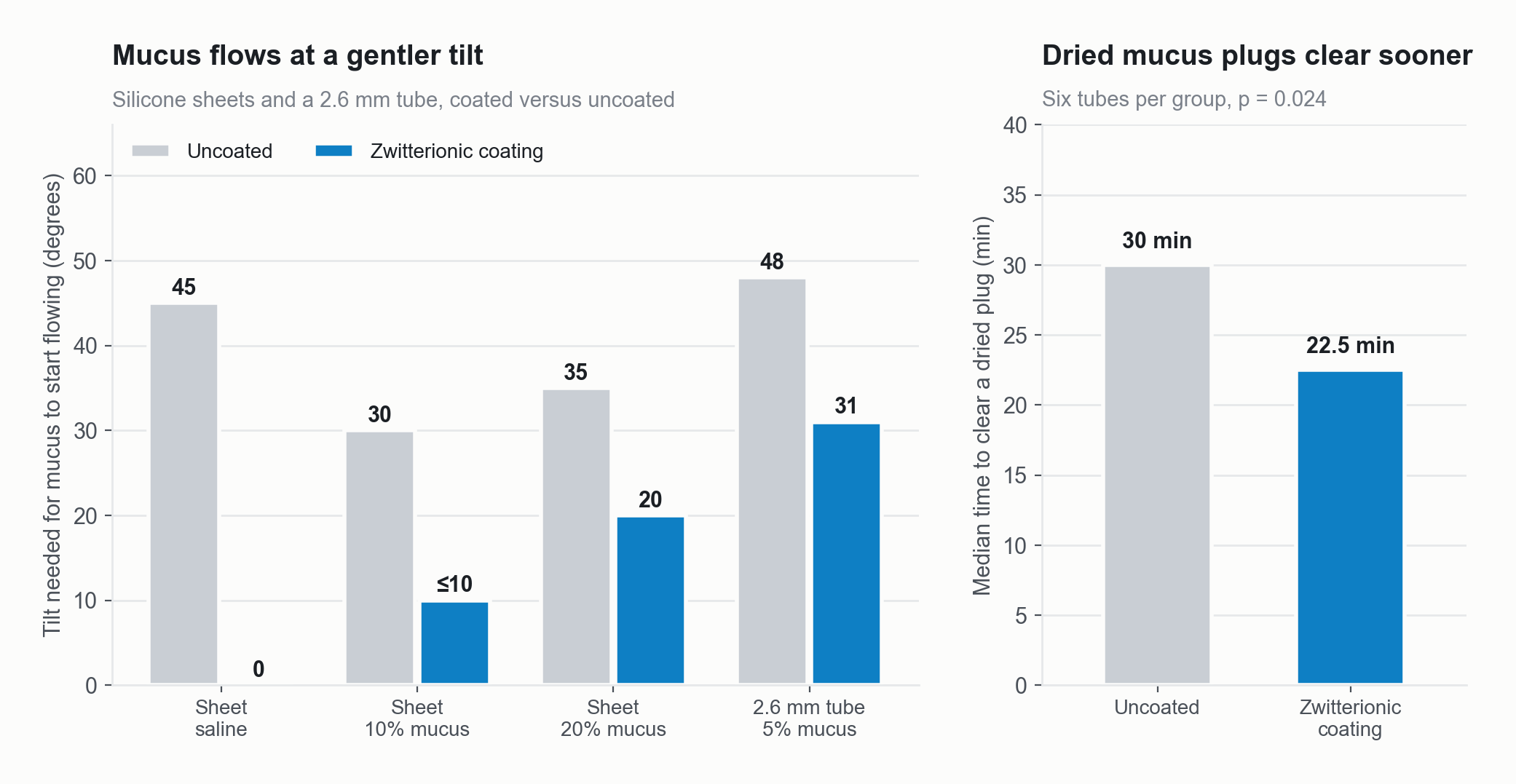
Zwitterionic grafted films let mucus flow at a gentler tilt on sheets and in a 2.6 mm tube, and cleared dried mucus plugs sooner.
Source: Horne R, Escudero C, Ellerman M, Guymon CA, Hansen M. Enhancing mucus flow and clearance by grafting zwitterionic hydrogel films to luminal surfaces. Laryngoscope Investig Otolaryngol 2025;10(2):e70118. doi:10.1002/lio2.70118
The coated cuff. Dip coating covers the tube and its cuff. The clip and the photograph show a coated cuff in our lab. They are images of a coated part, not performance data. Whether the film stretches with your cuff is measured in the feasibility round.
A coated endotracheal tube cuff inflating and deflating.
ZwiCoat, 2026
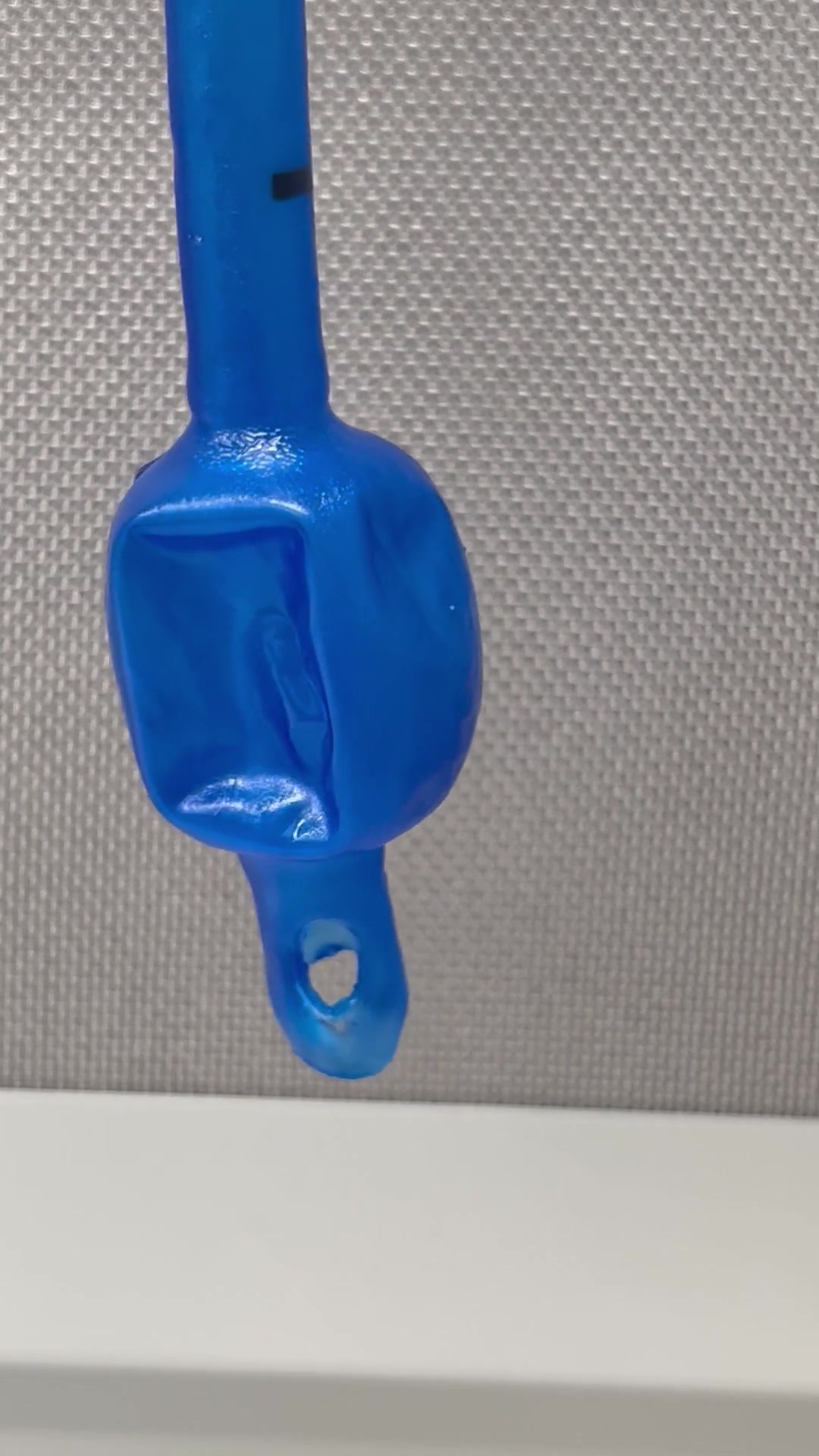
The cuff of a dip-coated endotracheal tube.
ZwiCoat, 2026
Insertion force, in human cadaveric cochleae. Coated cochlear implant arrays needed about half the peak force: about 42 percent less, 64.2 against 37.0 millinewtons (Bennion 2021, nine per group, p = 0.001), and about 50 percent less, about 68 against 35 millinewtons (Peel 2024, read from the figure). This is the published insertion-force model. It is not a tube result.
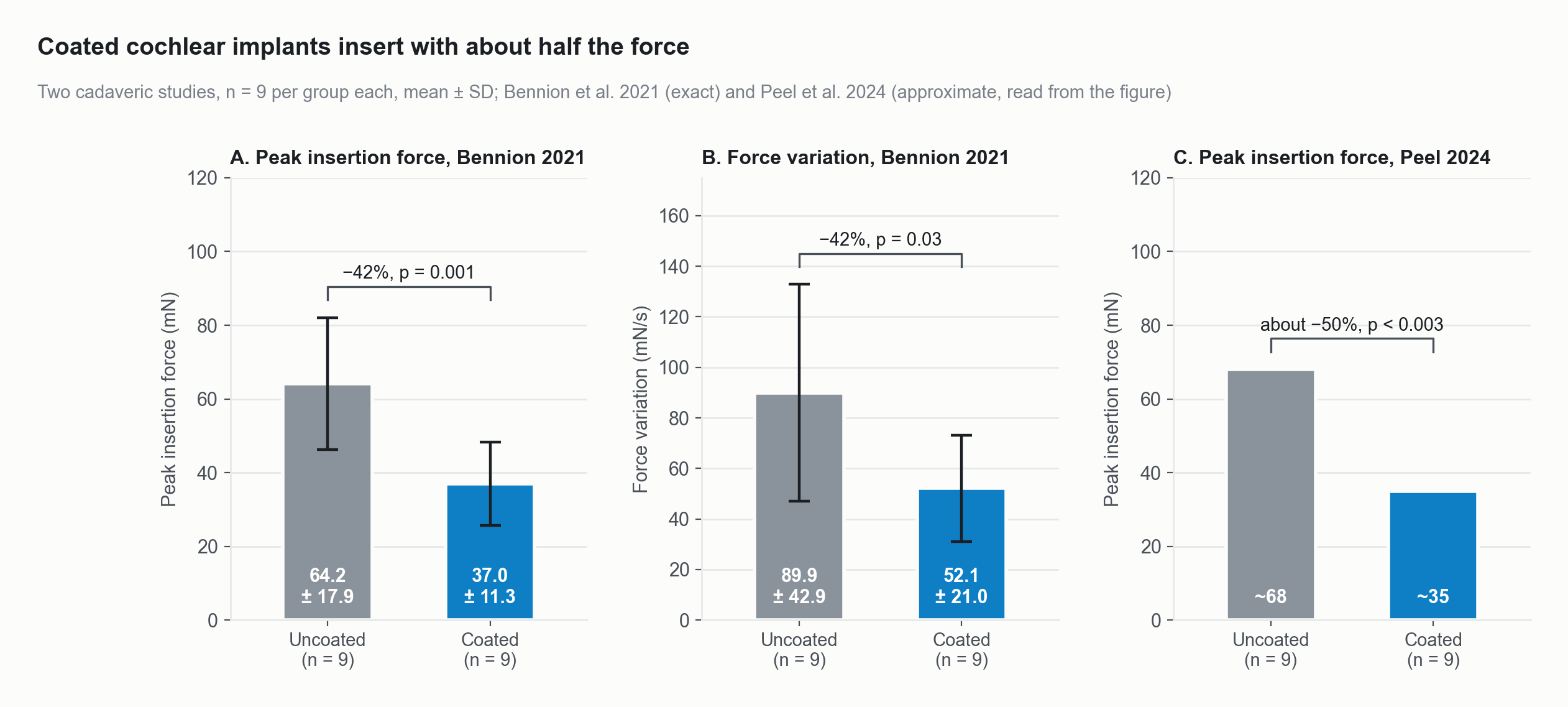
Coated cochlear implant arrays needed about half the peak insertion force of uncoated arrays in two human cadaveric studies: about 42 percent less (Bennion 2021) and about 50 percent less (Peel 2024).
Source: Bennion DM, Horne R, Peel A, Reineke P, Henslee A, Kaufmann C, Guymon CA, Hansen MR. Otology and Neurotology 2021;42(10):1476-1483, Fig 4A and 4B (means and SD from the text), doi:10.1097/MAO.0000000000003288; Peel A, Bennion D, Horne R, Hansen MR, Guymon CA. ACS Applied Bio Materials 2024;7:3124-3135, Fig 13A (values approximate, read from the published figure), doi:10.1021/acsabm.4c00156.
Friction and bacteria. Friction on coated silicone was more than 90 percent lower against steel, ceramic and guinea pig dermis (Bennion 2021), and at least 90 percent lower against guinea pig trachea (Peel 2024). In rats challenged with S. aureus, coated silicone carried about 155 bacteria per field at day 21, against about 940 uncoated (p < 0.0001). (Shen 2021.)
Why it drops in
The published adhesion data are on silicone, where the film failed inside the gel before the silicone interface let go (Leigh 2019). Bonding to PVC, the usual tube material, is measured in the feasibility round on your tubes. The coating is drug-free, so there is no antimicrobial agent to manage.
How to start
Send tubes with cuffs if you have them, and we return them coated, with matched controls and our adhesion and friction data. Start a feasibility round
References (12)
- Brodsky MB, Levy MJ, Jedlanek E, et al. Laryngeal injury and upper airway symptoms after oral endotracheal intubation with mechanical ventilation during critical care: a systematic review. Crit Care Med. 2018;46(12):2010-2017. doi:10.1097/CCM.0000000000003368
- Gil-Perotin S, Ramirez P, Marti V, et al. Implications of endotracheal tube biofilm in ventilator-associated pneumonia response: a state of concept. Crit Care. 2012;16(3):R93. doi:10.1186/cc11357
- Zimlichman E, et al. Health care-associated infections: a meta-analysis of costs and financial impact on the US health care system. JAMA Intern Med. 2013;173(22):2039-2046.
- Manica D, Schweiger C, Maróstica PJ, Kuhl G, Carvalho PR. Association between length of intubation and subglottic stenosis in children. Laryngoscope. 2013;123(4):1049-1054. doi:10.1002/lary.23771
- Tokmaji G, Vermeulen H, Muller MC, Kwakman PH, Schultz MJ, Zaat SA. Silver-coated endotracheal tubes for prevention of ventilator-associated pneumonia in critically ill patients. Cochrane Database Syst Rev. 2015;(8):CD009201.
- Yang Y, Xiong X, Wang X, Dong Q, Pan L. Prevention of ventilator-associated pneumonia by metal-coated endotracheal tubes: a meta-analysis. Crit Care. 2024;28(1):309.
- Horne R, Escudero C, Ellerman M, Guymon CA, Hansen M. Enhancing mucus flow and clearance by grafting zwitterionic hydrogel films to luminal surfaces. Laryngoscope Investig Otolaryngol. 2025;10(2):e70118.
- Bennion DM, Horne R, Peel A, et al. Zwitterionic photografted coatings of cochlear implant biomaterials reduce friction and insertion forces. Otol Neurotol. 2021;42(10):1476-1483.
- Peel A, Bennion D, Horne R, Hansen MR, Guymon CA. Photografted zwitterionic hydrogel coating durability for reduced foreign body response to cochlear implants. ACS Appl Bio Mater. 2024;7(5):3124-3135.
- Leigh BL, Cheng E, Xu L, Derk A, Hansen MR, Guymon CA. Antifouling photograftable zwitterionic coatings on PDMS substrates. Langmuir. 2019;35(4):1100-1110.
- Shen N, Cheng E, Whitley JW, et al. Photograftable zwitterionic coatings prevent Staphylococcus aureus and Staphylococcus epidermidis adhesion to PDMS surfaces. ACS Appl Bio Mater. 2021;4(2):1283-1293.
- Horne R, Ben-Shlomo N, Jensen M, et al. Reducing the foreign body response on human cochlear implants and their materials in vivo with photografted zwitterionic hydrogel coatings. Acta Biomater. 2023;166:212-223.