
Application
Indwelling catheters
ZwiGuard™ is a drug-free coating for urinary and drainage catheters, tested on silicone for protein, cell and bacterial adhesion, with no urine data yet.
- Devices
- Foley and intermittent catheters, ureteral stents, surgical drains
- Substrates
- silicone (published); PVC, PEEK, parylene-C and polyurethane (ZwiCoat internal tests); others in the feasibility round
- Thickness
- tunable, from a few micrometres to 100 micrometres or more (ZwiCoat process range); about 7 micrometres in the published silicone work (Leigh 2019)
- Sterilization
- validated on your cycle during joint development
- Regulatory path
- traditional 510(k); zwitterion-modified silicone Foley catheters are already cleared (K192034 through K233013)
- Evidence
- in vitro; rats, up to 21 days; mice, one year under the skin; urine not yet measured
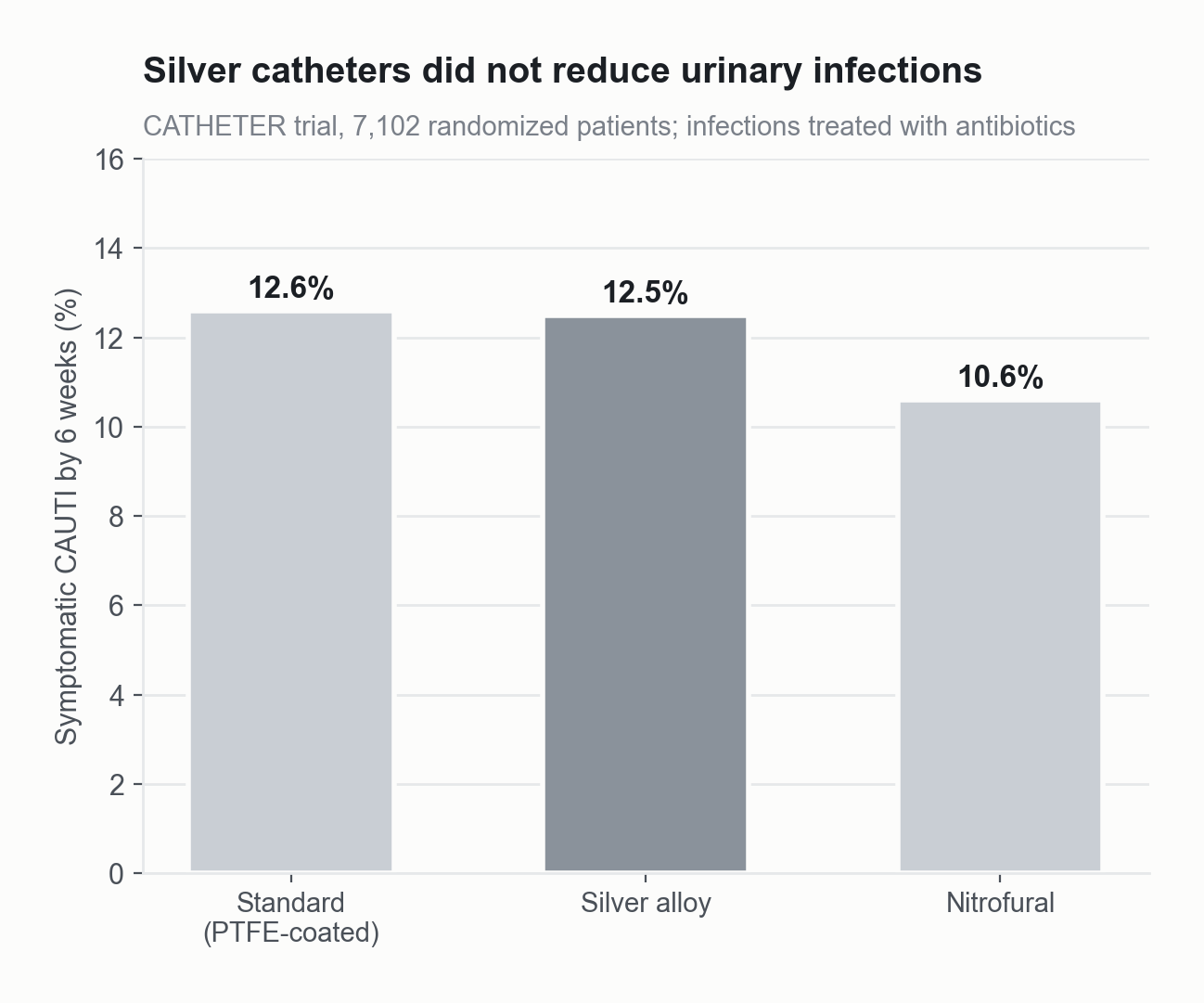
In the CATHETER trial, silver alloy urinary catheters did not lower symptomatic catheter-associated urinary tract infection (12.5 percent) compared with standard catheters (12.6 percent).
Source: Pickard R, Lam T, MacLennan G, et al. Antimicrobial catheters for reduction of symptomatic urinary tract infection in adults requiring short-term catheterisation in hospital: a multicentre randomised controlled trial (CATHETER). Lancet 2012;380(9857):1927-1935. doi:10.1016/S0140-6736(12)61380-4
The problem
About 75 percent of hospital urinary tract infections are catheter-associated (CDC 2025). Bacteriuria develops at 3 to 10 percent per day of catheterization (Gould 2010). Blockage is the long-term failure. In a laboratory bladder model, none of 18 catheter types, including hydrogel- and silver-coated ones, resisted encrustation by Proteus (Morris 1997). In a 12-week follow-up of 54 long-term users, 48 percent had a blockage (Kohler-Ockmore 1996).
Silver has not changed the picture. In the CATHETER trial of 7,102 patients, symptomatic infection by six weeks was 12.6 percent with standard catheters and 12.5 percent with silver alloy catheters. A nitrofural catheter reached 10.6 percent (Pickard 2012). The chart above shows the trial.
What ZwiGuard does here
Every result below is from a published study on silicone. No urine data are published.
Protein, cells and bacteria. On coated silicone in vitro, fibrinogen adsorption fell by more than 90 percent, and fibroblast attachment fell 20-fold or more (Leigh 2019). S. aureus adhesion fell about 97 percent and S. epidermidis adhesion about 93 percent (Shen 2021).
Bacteria, in rats. In rats challenged with S. aureus, coated implants carried about 155 bacteria per field at day 21, against about 940 uncoated (p < 0.0001). A coating kept two weeks in a rat still resisted a fresh challenge (Shen 2021).
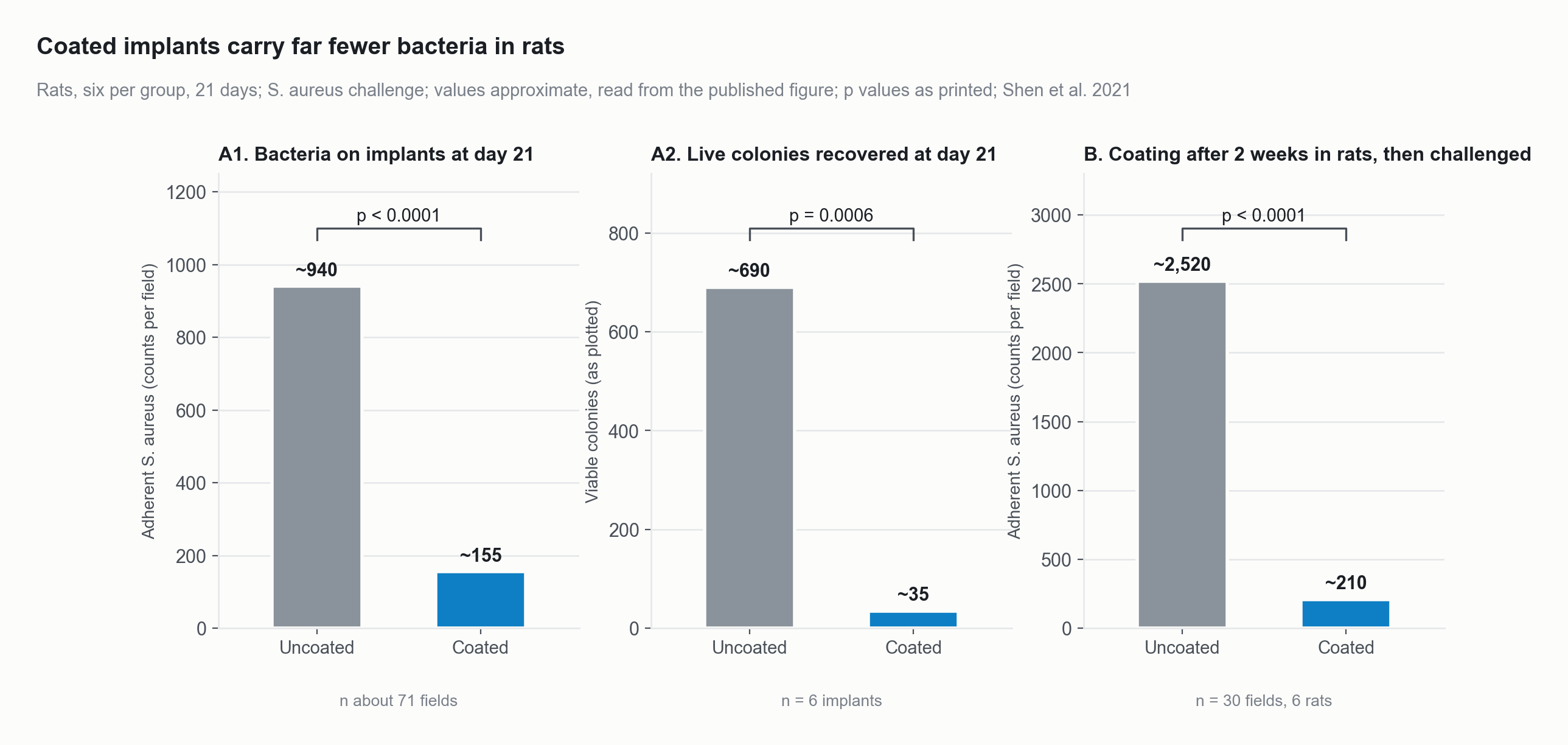
In rats challenged with S. aureus, coated silicone implants carried far fewer bacteria and live colonies at day 21, and a coating kept in a rat for two weeks still resisted a fresh S. aureus challenge.
Source: Shen N, Cheng E, Whitley JW, Horne RR, Leigh B, Xu L, Jones BD, Guymon CA, Hansen MR. Photograftable zwitterionic coatings prevent Staphylococcus aureus and Staphylococcus epidermidis adhesion to PDMS surfaces. ACS Applied Bio Materials 2021;4(2):1283-1293, Figs 7C, 7D and 8 (values approximate, read from the published figure; p values as printed). doi:10.1021/acsabm.0c01147
Friction. Coated silicone kept about 90 percent lower friction after three weeks in mice, and at least 90 percent lower against five guinea pig tissues and steel (Peel 2024; Bennion 2021). FDA has cleared zwitterion-modified silicone Foley catheters (K192034 through K233013).
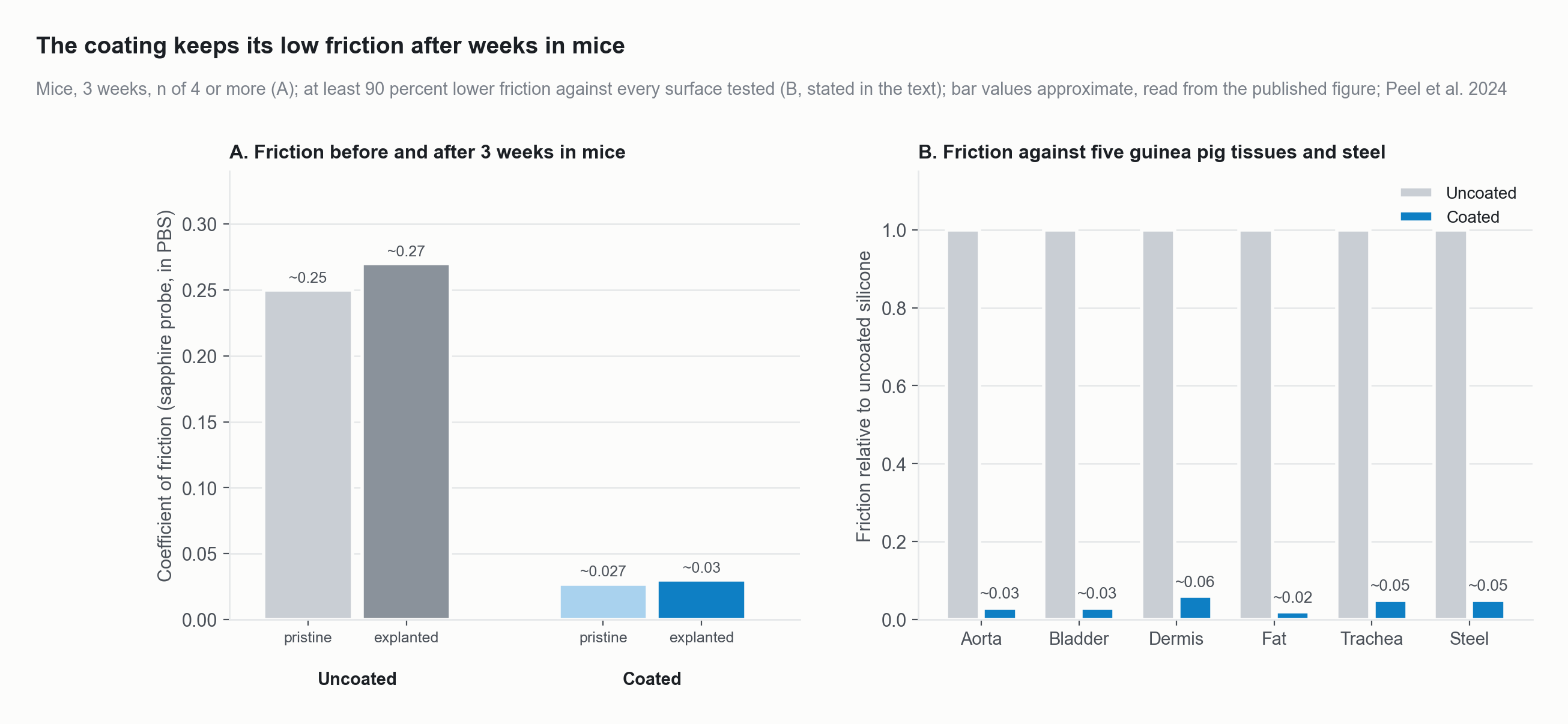
Friction of uncoated vs coated silicone, before and after three weeks in mice (panel A). Coated silicone kept about 90 percent lower friction, and had at least 90 percent lower friction against five guinea pig tissues and steel.
Source: Peel A, Bennion D, Horne R, Hansen MR, Guymon CA. ACS Applied Bio Materials 2024;7:3124-3135, Figs 4 and 5A (values approximate, read from the published figure; the at-least-90-percent statement is from the text). doi:10.1021/acsabm.4c00156
Durability. Antifouling was unchanged after six months in mice, and the film was intact at one year (Horne 2023).
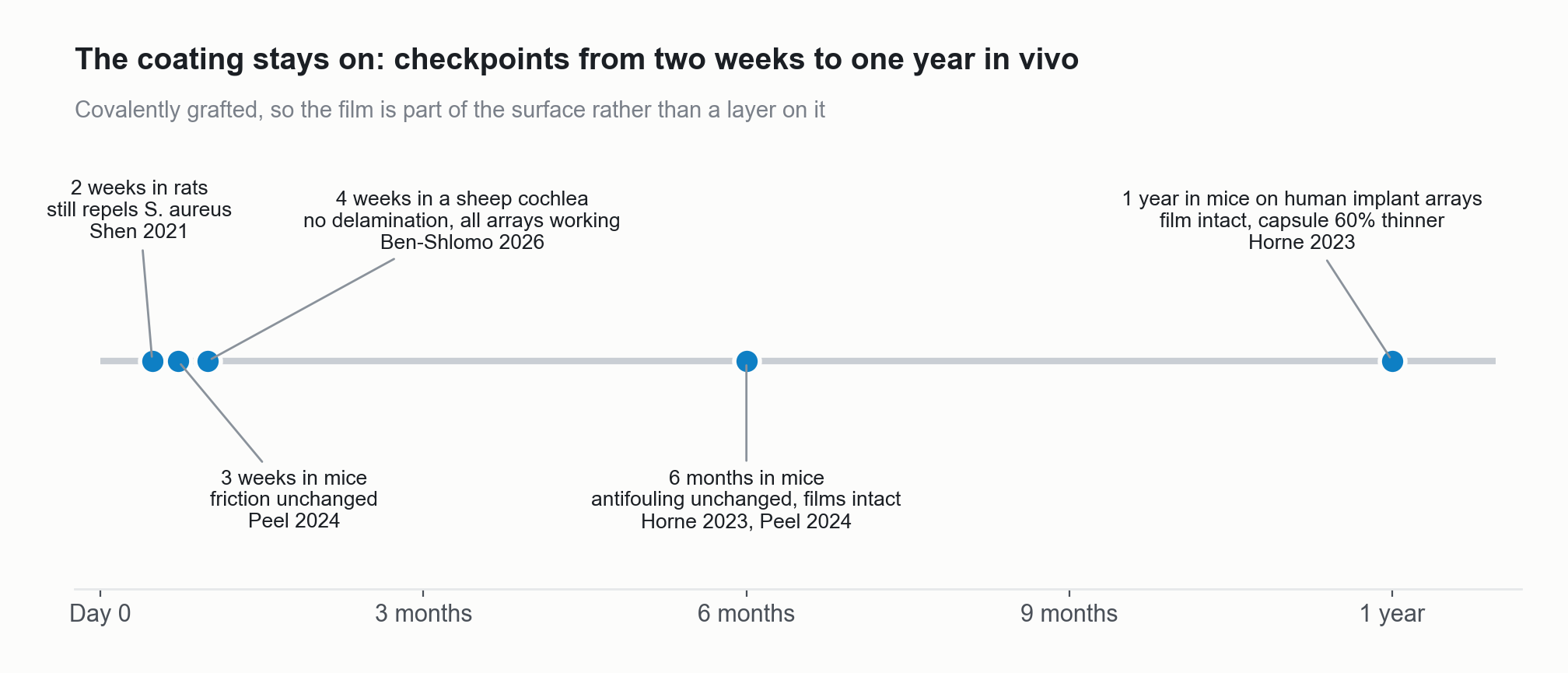
In-vivo durability checkpoints from two weeks to one year.
Source: Shen 2021; Peel 2024; Ben-Shlomo 2026; Horne 2023
Not yet measured. Urine, encrustation and Gram-negative bacteria. The feasibility round measures adhesion and friction on your catheter. Your team runs bladder-model and urine tests on the coated parts.
Why it drops in
One chemistry and one dip step serve urinary, drainage and vascular lines. The coating is applied to the outer wall and the lumen together. One development program and one Device Master File can carry across a product line. The film is drug-free, so there is no antimicrobial to manage. Bonding to PVC and polyurethane catheters is measured in the feasibility round on your parts.
How to start
Pick one catheter line and send us a few; we return them coated, with matched uncoated controls and our adhesion and friction data. Start a feasibility round
References (11)
- Centers for Disease Control and Prevention. Catheter-associated Urinary Tract Infection (CAUTI) Basics. Page dated June 27, 2025. cdc.gov/uti/about/cauti-basics.html
- Gould CV, Umscheid CA, Agarwal RK, Kuntz G, Pegues DA; HICPAC. Guideline for prevention of catheter-associated urinary tract infections 2009. Infect Control Hosp Epidemiol. 2010;31(4):319-326.
- Morris NS, Stickler DJ, Winters C. Which indwelling urethral catheters resist encrustation by Proteus mirabilis biofilms? Br J Urol. 1997;80:58-63.
- Kohler-Ockmore J, Feneley RC. Long-term catheterization of the bladder: prevalence and morbidity. Br J Urol. 1996;77:347-351.
- Pickard R, Lam T, MacLennan G, et al. Antimicrobial catheters for reduction of symptomatic urinary tract infection in adults requiring short-term catheterisation in hospital: a multicentre randomised controlled trial (CATHETER). Lancet. 2012;380(9857):1927-1935.
- Leigh BL, Cheng E, Xu L, Derk A, Hansen MR, Guymon CA. Antifouling photograftable zwitterionic coatings on PDMS substrates. Langmuir. 2019;35(4):1100-1110.
- Horne R, Ben-Shlomo N, Jensen M, et al. Reducing the foreign body response on human cochlear implants and their materials in vivo with photografted zwitterionic hydrogel coatings. Acta Biomater. 2023;166:212-223.
- Shen N, Cheng E, Whitley JW, et al. Photograftable zwitterionic coatings prevent Staphylococcus aureus and Staphylococcus epidermidis adhesion to PDMS surfaces. ACS Appl Bio Mater. 2021;4(2):1283-1293.
- Bennion DM, Horne R, Peel A, et al. Zwitterionic photografted coatings of cochlear implant biomaterials reduce friction and insertion forces. Otol Neurotol. 2021;42(10):1476-1483.
- Horne R, Escudero C, Ellerman M, Guymon CA, Hansen M. Enhancing mucus flow and clearance by grafting zwitterionic hydrogel films to luminal surfaces. Laryngoscope Investig Otolaryngol. 2025;10(2):e70118.
- FDA 510(k) summaries K192034, K221625, K222118 and K233013 (zwitterion-modified silicone Foley catheters). accessdata.fda.gov.