
Application
Vascular access
ZwiGuard™ is a drug-free coating that grafts inside and outside a catheter in one dip step, tested on silicone for protein, cell and bacterial adhesion.
- Devices
- PICCs, central venous catheters, midlines, implanted ports, dialysis catheters
- Substrates
- silicone (published); PVC, PEEK, parylene-C and polyurethane (ZwiCoat internal tests); others in the feasibility round
- Thickness
- tunable, from a few micrometres to 100 micrometres or more (ZwiCoat process range); about 7 micrometres in the published silicone work (Leigh 2019)
- Sterilization
- validated on your cycle during joint development
- Regulatory path
- traditional 510(k) with a Pre-Submission; a zwitterionic-surface PICC (K113225) is already cleared
- Evidence
- in vitro; rats, up to 21 days; mice, one year under the skin; not measured in blood
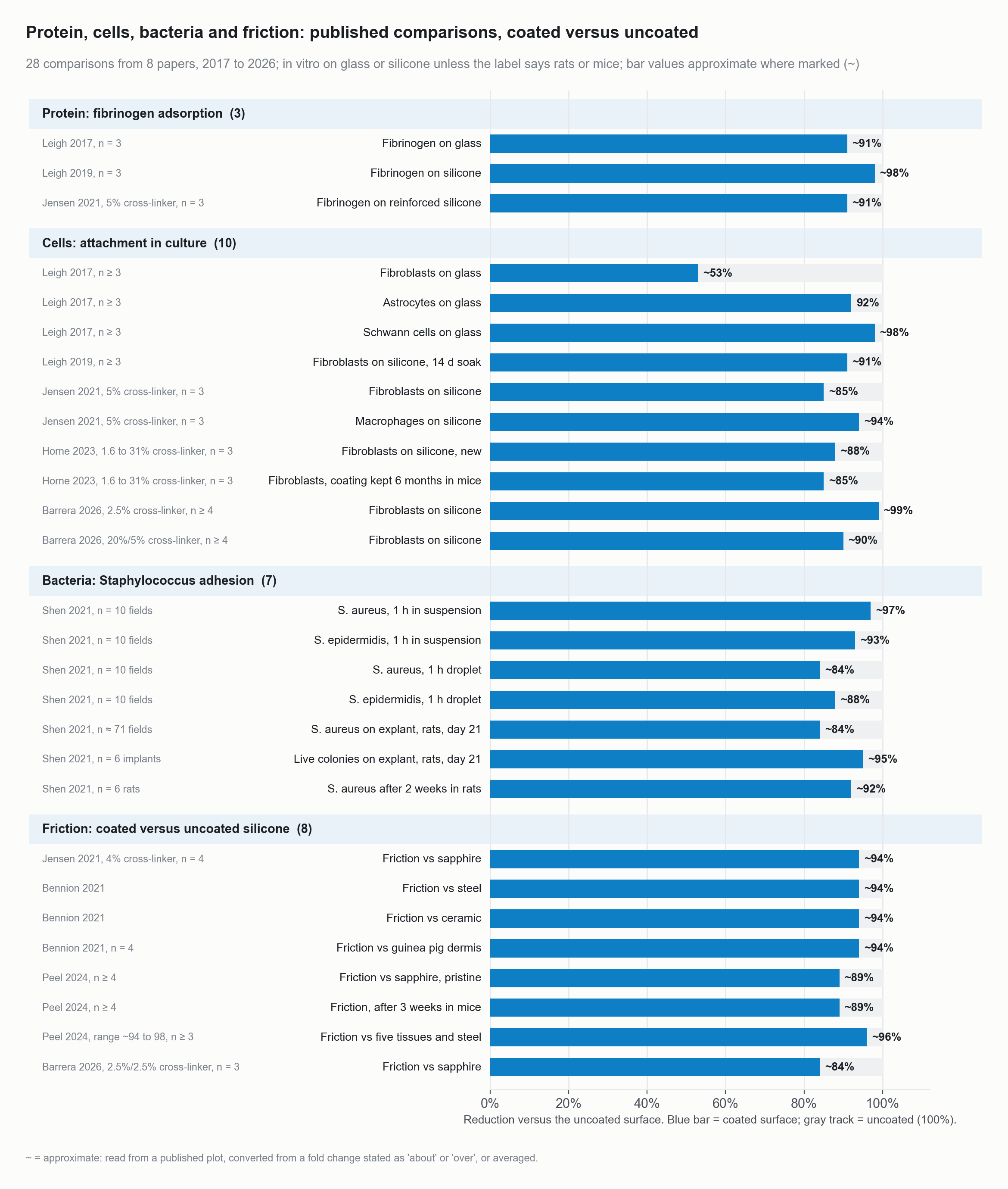
Protein, cells, bacteria and friction: every published bench comparison of coated versus uncoated surfaces (38 bars from 8 papers), as percent reduction.
Source: Leigh BL, et al. Biomacromolecules 2017;18(8):2389-2401 (Fig 4 fibrinogen; Figs 6E, 7E, 8E cells on glass; fibrinogen and fibroblast values read from the published plots, astrocyte and Schwann cell values from the stated fold changes); Leigh BL, et al. Langmuir 2019;35(4):1100-1110 (Fig 7D fibrinogen; Fig 10D fibroblasts after 14 days in medium, plotted ratios used because the plotted absolute values conflict with the text); Jensen MJ, et al. ACS Biomaterials Science and Engineering 2021;7(9):4494-4502 (Figs 1G, 2G, 3G at 5 percent cross-linker; Fig 5A friction at 4 percent; values read from the published plots); Shen N, et al. ACS Applied Bio Materials 2021;4(2):1283-1293 (Fig 3 in vitro, Figs 7C, 7D rat explants at day 21, Fig 8 after 2 weeks in rats; values read from the published plots); Horne R, et al. Acta Biomaterialia 2023;166:212-223 (Fig 3F, mean of four cross-linker levels, new and after 6 months in mice; read from the published plot); Bennion DM, et al. Otology and Neurotology 2021;42(10):1476-1483 (Fig 1B, steel, ceramic and guinea pig dermis; text states more than 90 percent lower, p < 0.0001); Peel A, et al. ACS Applied Bio Materials 2024;7:3124-3135 (Fig 4 pristine and after 3 weeks in mice; Fig 5A six probes, bar shows the mean, range in the label; read from the published plots); Barrera G, et al. ACS Applied Polymer Materials 2026;8(18):16328-16338, doi:10.1021/acsapm.6c02510 (Fig 6 fibroblasts, text states more than 99 percent for low and about 90 percent for high cross-linker; Fig 4B friction, best group 2.5/2.5 percent).
The problem
Within seconds of insertion, plasma protein coats the inside and the outside of a catheter. Inside, the film seeds fibrin sheath and occlusion. Occlusion developed in 12 percent of PICCs in a large multihospital study (Smith 2017). Dysfunction forces removal of up to 20 percent of dialysis catheters (Lazarus 2025). Outside, the film gives thrombus and staphylococci a foothold. One central-line bloodstream infection costs about $46,000, in 2012 dollars (Zimlichman 2013). PICCs carry 2.55 times the odds of deep-vein thrombosis of other central lines (Chopra 2013).
Today’s fixes act after the film forms. Antimicrobial catheters cut bloodstream infection by about 2 percent in absolute terms (Lai 2016). In the PICNIC trial, catheter failure was 5.9 percent with a hydrophobic PICC, 9.9 percent with a chlorhexidine PICC and 6.1 percent with a standard polyurethane PICC (Ullman 2025).
What ZwiGuard does here
Every result below is from a published study on silicone, in the laboratory or under the skin of an animal. None was measured in flowing blood.
Protein, cells and bacteria. The chart above gathers the bench results. On coated silicone, fibrinogen adsorption fell by more than 90 percent, and fibroblast attachment fell 20-fold or more (Leigh 2019). S. aureus adhesion fell about 97 percent and S. epidermidis adhesion about 93 percent. Those two species cause 45 percent of bloodstream infections in dialysis patients (Nguyen 2017). In rats challenged with S. aureus, coated implants carried about 155 bacteria per field at day 21, against about 940 uncoated (p < 0.0001). (Shen 2021.)
Friction. Coated silicone kept about 90 percent lower friction after three weeks in mice, and had at least 90 percent lower friction against five guinea pig tissues and steel (Peel 2024; Bennion 2021).
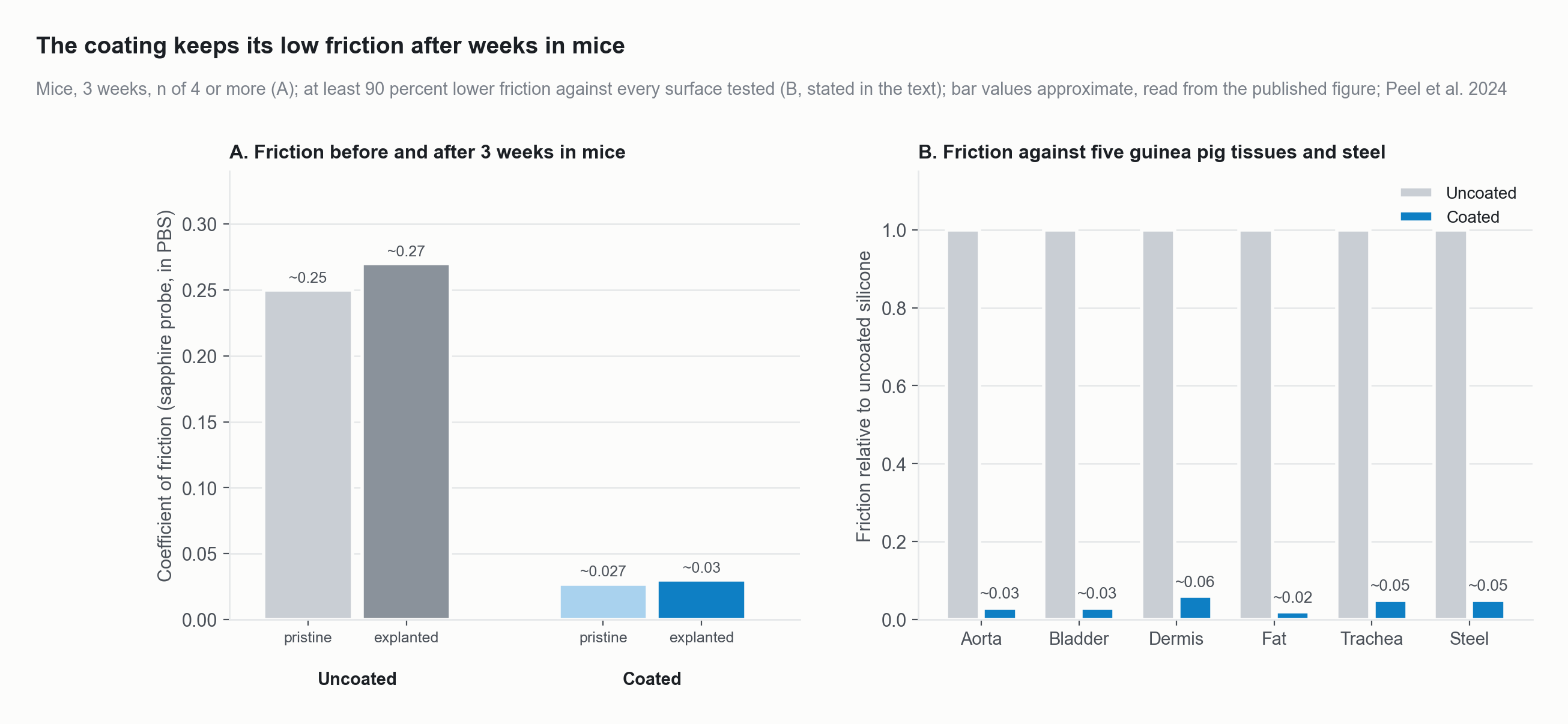
Friction of uncoated vs coated silicone, before and after three weeks in mice (panel A). Coated silicone kept about 90 percent lower friction, and had at least 90 percent lower friction against five guinea pig tissues and steel.
Source: Peel A, Bennion D, Horne R, Hansen MR, Guymon CA. ACS Applied Bio Materials 2024;7:3124-3135, Figs 4 and 5A (values approximate, read from the published figure; the at-least-90-percent statement is from the text). doi:10.1021/acsabm.4c00156
Durability. Antifouling was unchanged after six months in mice, and the film was intact at one year (Horne 2023). In rats, a coating kept two weeks under the skin still resisted a fresh S. aureus challenge (Shen 2021).
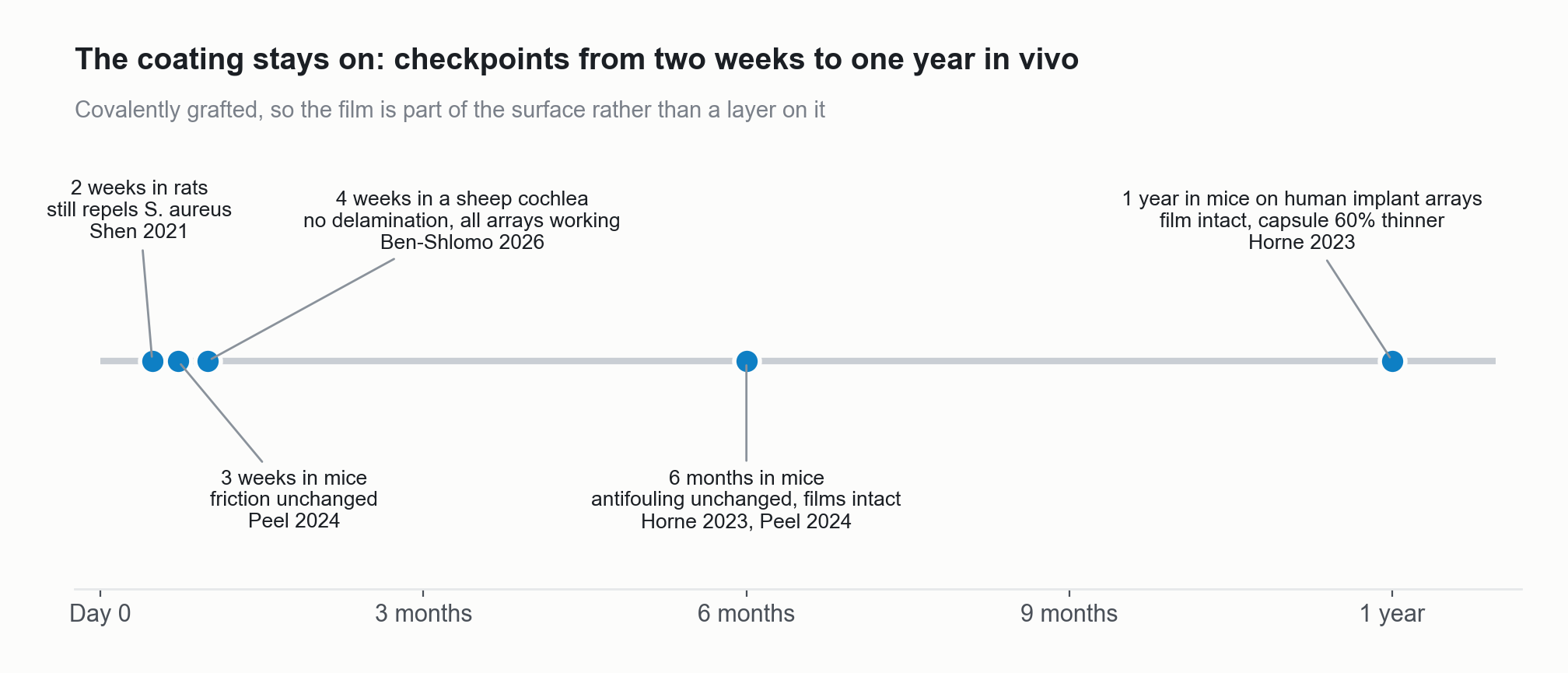
In-vivo durability checkpoints from two weeks to one year.
Source: Shen 2021; Peel 2024; Ben-Shlomo 2026; Horne 2023
Why it drops in
One dip step coats the outer wall and the lumen. The film is grafted and crosslinked in one UV step. Bond strength rises with the grafting agent until the film fails inside the gel, not at the silicone interface.
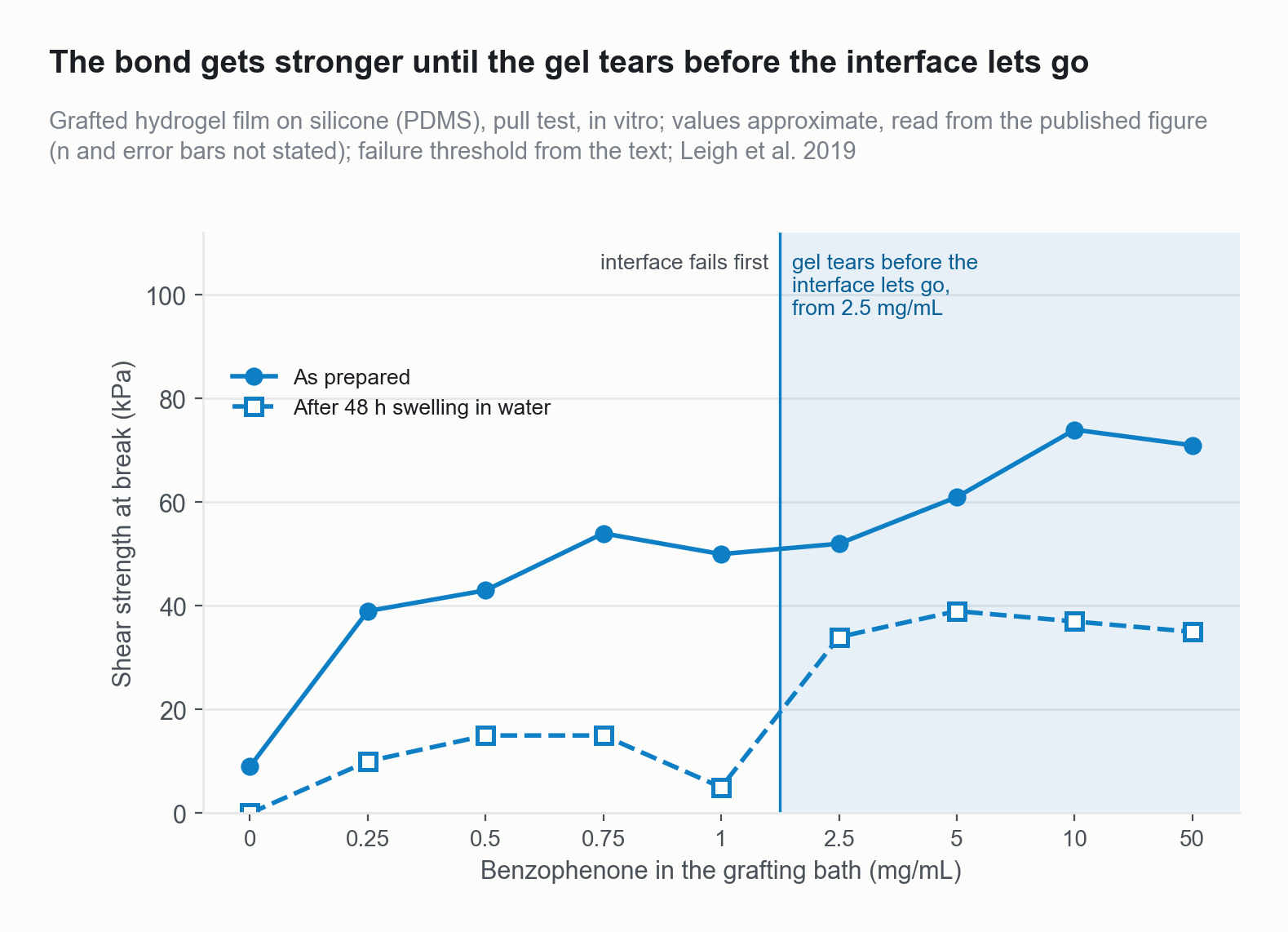
Shear bond strength of the zwitterionic film on silicone rises with benzophenone grafting agent until failure moves from the silicone interface into the gel itself, at 2.5 mg/mL.
Source: Leigh BL, Cheng E, Xu L, Derk A, Hansen MR, Guymon CA. Langmuir 2019;35(4):1100-1110, Fig 6 (values approximate, read from the published figure and converted from N/m2 x 10^4 to kPa; failure thresholds from the text, 2.5 mg/mL for SBMA and 5 mg/mL for CBMA). doi:10.1021/acs.langmuir.8b00838
Zwitterionic catheter surfaces have precedent. A grafted sulfobetaine surface cut thrombus about 99 percent in a canine model (Smith 2012), and FDA cleared a zwitterionic-surface PICC (K113225). Neither is a ZwiGuard result. ZwiGuard carries no drug, so there is nothing to deplete and no combination product. Bonding to polyurethane and PVC catheters is measured in the feasibility round.
How to start
Send catheters and we coat the outside and the lumen at no cost; your team runs flow and blood-contact tests on the coated parts. Start a feasibility round
References (14)
- Leigh BL, Cheng E, Xu L, Derk A, Hansen MR, Guymon CA. Antifouling photograftable zwitterionic coatings on PDMS substrates. Langmuir. 2019;35(4):1100-1110.
- Horne R, Ben-Shlomo N, Jensen M, et al. Reducing the foreign body response on human cochlear implants and their materials in vivo with photografted zwitterionic hydrogel coatings. Acta Biomater. 2023;166:212-223.
- Shen N, Cheng E, Whitley JW, et al. Photograftable zwitterionic coatings prevent Staphylococcus aureus and Staphylococcus epidermidis adhesion to PDMS surfaces. ACS Appl Bio Mater. 2021;4(2):1283-1293.
- Bennion DM, Horne R, Peel A, et al. Zwitterionic photografted coatings of cochlear implant biomaterials reduce friction and insertion forces. Otol Neurotol. 2021;42(10):1476-1483.
- Horne R, Escudero C, Ellerman M, Guymon CA, Hansen M. Enhancing mucus flow and clearance by grafting zwitterionic hydrogel films to luminal surfaces. Laryngoscope Investig Otolaryngol. 2025;10(2):e70118.
- Smith SN, Moureau N, Vaughn VM, et al. Patterns and predictors of peripherally inserted central catheter occlusion: the 3P-O study. J Vasc Interv Radiol. 2017;28(5):749-756.e2.
- Lazarus B, Lok CE, Moist L, Polkinghorne KR. Strategies to prevent hemodialysis catheter dysfunction. J Am Soc Nephrol. 2025;36(5):952-966.
- Zimlichman E, et al. Health care-associated infections: a meta-analysis of costs and financial impact on the US health care system. JAMA Intern Med. 2013;173(22):2039-2046.
- Chopra V, et al. Risk of venous thromboembolism associated with peripherally inserted central catheters: a systematic review and meta-analysis. Lancet. 2013;382:311-325.
- Nguyen DB, et al. National Healthcare Safety Network (NHSN) dialysis event surveillance report for 2014. Clin J Am Soc Nephrol. 2017;12:1139-1146.
- Lai NM, et al. Catheter impregnation, coating or bonding for reducing central venous catheter-related infections in adults. Cochrane Database Syst Rev. 2016;3(3):CD007878.
- Ullman AJ, et al. A comparison of peripherally inserted central catheter materials (PICNIC). N Engl J Med. 2025;392(2):161-172.
- Smith RS, Zhang Z, Bouchard M, et al. Vascular catheters with a nonleaching poly-sulfobetaine surface modification reduce thrombus formation and microbial attachment. Sci Transl Med. 2012;4(153):153ra132.
- FDA 510(k) summary K113225 (Nylus PICC, Semprus BioSciences; decision November 6, 2012). accessdata.fda.gov.