
Application
PEEK and orthopedic
ZwiGuard™ is a drug-free coating whose published data are on silicone, so PEEK bonding is measured in the feasibility round on your parts.
- Devices
- PEEK cranial and spinal implants, interventional sheaths and catheters
- Substrates
- silicone (published, Leigh 2019); PEEK and polyurethane (ZwiCoat internal tests); your PEEK grade and surface in the feasibility round
- Thickness
- tunable, from a few micrometres to 100 micrometres or more (ZwiCoat process range); about 7 micrometres in the published silicone work (Leigh 2019)
- Sterilization
- validated on your cycle during joint development
- Regulatory path
- 510(k) or PMA supplement, set by the device; our Master File supports the filing
- Evidence
- silicone: in vitro; rats, 21 days; mice, one year; PEEK: none published
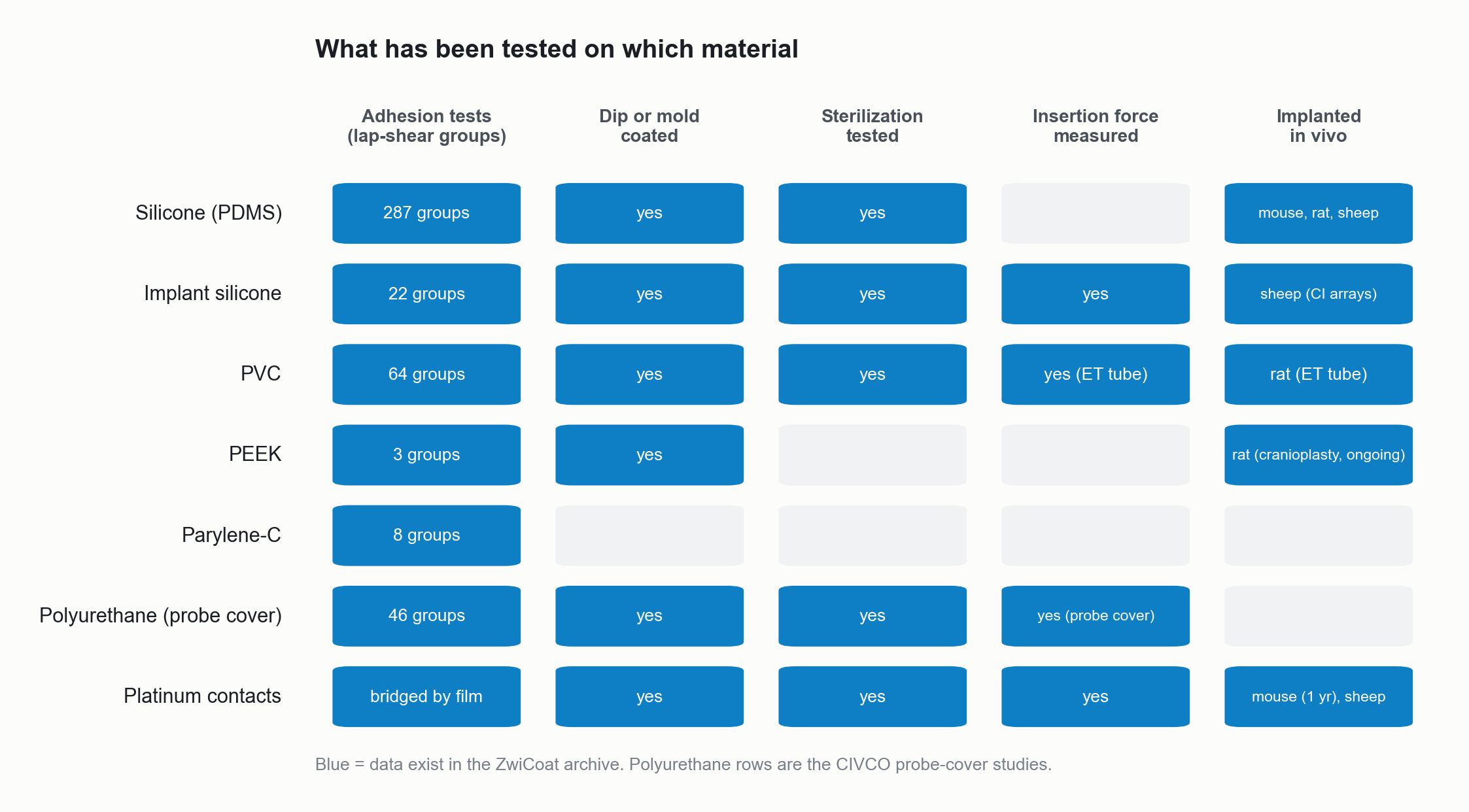
Evidence matrix: substrates versus the kinds of test on record. Blue means data exist in the ZwiCoat archive; polyurethane is the CIVCO probe cover.
Source: ZwiCoat Lap-shear Master database; archived experiment reports; published studies. Adhesion on silicone is published (Leigh 2019); the other cells are internal ZwiCoat tests.
The problem
Infection caused about 25 percent of knee revisions and about 15 percent of hip revisions in US national data (Bozic 2010; Bozic 2009). A two-stage revision for infection costs more than twice an aseptic one (Yao 2021). Staphylococci cause 50 to 60 percent of these infections, and they resist antibiotics once they form a biofilm (Tande 2014; Costerton 1999).
PEEK has its own problems. It is hydrophobic and lacks direct bone contact (Walsh 2015). Most bacterial strains tested adhered more to PEEK than to titanium (Sarfraz 2022). In a pooled analysis of 183 PEEK cranioplasties, 15 percent had complications (Punchak 2017). Antibiotic-loaded bone cement did not significantly change one-year revision for infection in registry data on 1.9 million knee replacements (Leta 2024). On interventional devices, FDA has documented lubricious coatings peeling, flaking and shedding (FDA 2019).
What ZwiGuard does here
No PEEK data are published. The matrix above shows where ZwiCoat has its own tests on PEEK and other substrates. Every published result below was measured on silicone, or on silicone and platinum arrays.
Bonding, on silicone. The film bonds so firmly that it fails inside the gel before the silicone interface lets go. Bond strength rises with the grafting agent until that point (Leigh 2019). The feasibility round measures whether the same holds on your PEEK, titanium or cobalt-chrome part.
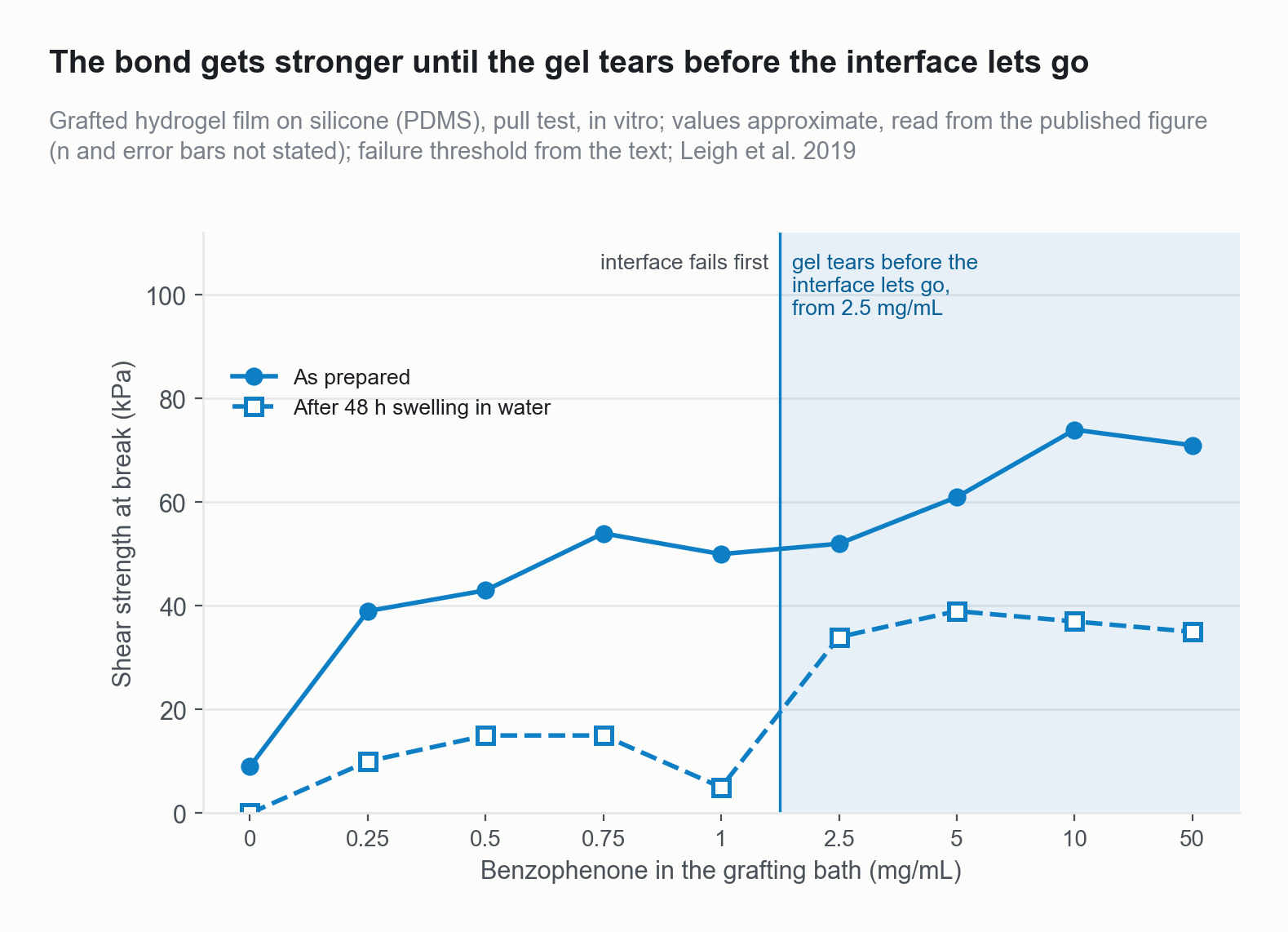
Shear bond strength of the zwitterionic film on silicone rises with benzophenone grafting agent until failure moves from the silicone interface into the gel itself, at 2.5 mg/mL.
Source: Leigh BL, Cheng E, Xu L, Derk A, Hansen MR, Guymon CA. Langmuir 2019;35(4):1100-1110, Fig 6 (values approximate, read from the published figure and converted from N/m2 x 10^4 to kPa; failure thresholds from the text, 2.5 mg/mL for SBMA and 5 mg/mL for CBMA). doi:10.1021/acs.langmuir.8b00838
Bacteria. S. aureus adhesion fell about 97 percent and S. epidermidis adhesion about 93 percent on coated silicone in vitro. In rats challenged with S. aureus, coated implants carried about 155 bacteria per field at day 21, against about 940 uncoated (p < 0.0001). (Shen 2021.)
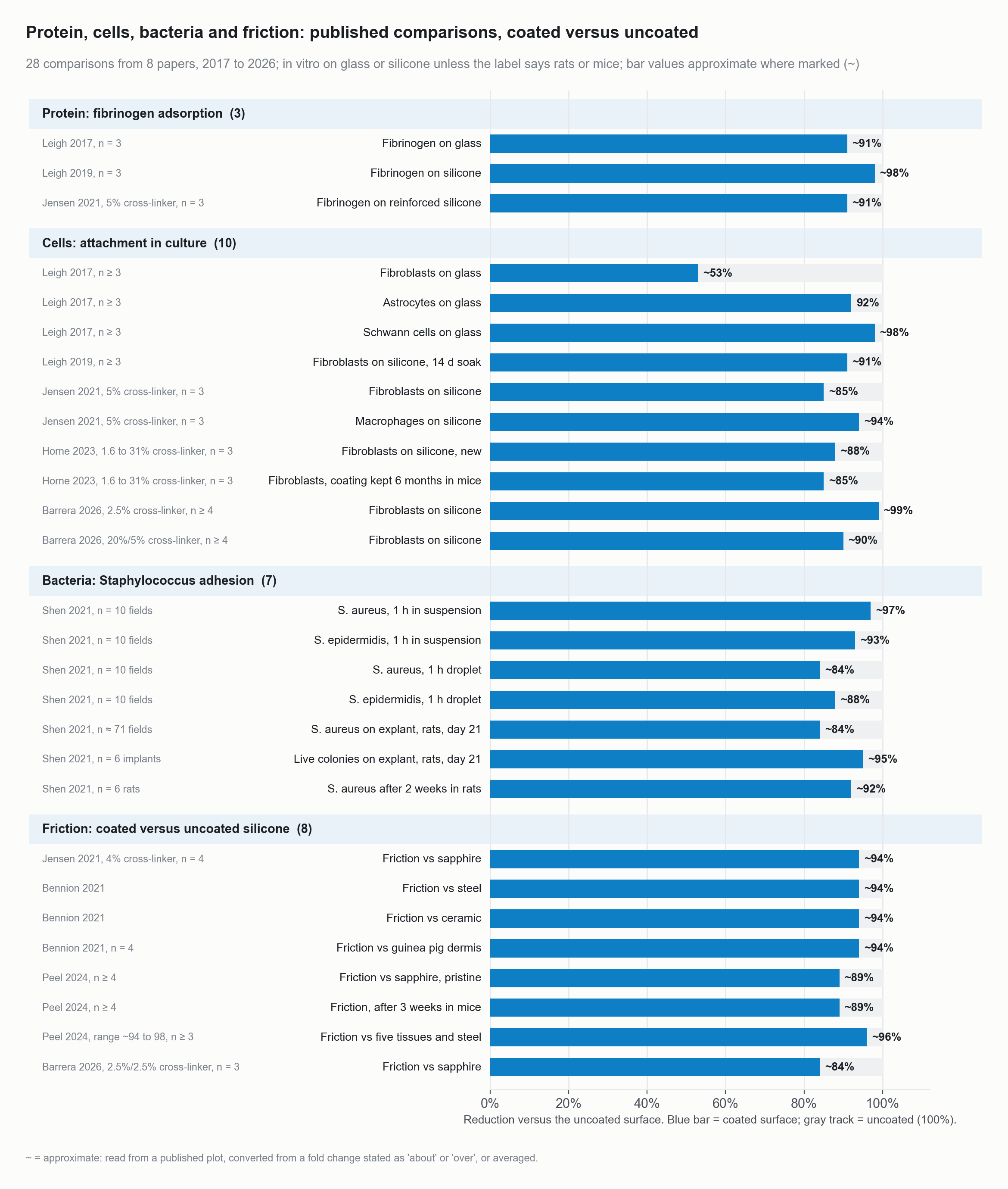
Protein, cells, bacteria and friction: every published bench comparison of coated versus uncoated surfaces (38 bars from 8 papers), as percent reduction.
Source: Leigh BL, et al. Biomacromolecules 2017;18(8):2389-2401 (Fig 4 fibrinogen; Figs 6E, 7E, 8E cells on glass; fibrinogen and fibroblast values read from the published plots, astrocyte and Schwann cell values from the stated fold changes); Leigh BL, et al. Langmuir 2019;35(4):1100-1110 (Fig 7D fibrinogen; Fig 10D fibroblasts after 14 days in medium, plotted ratios used because the plotted absolute values conflict with the text); Jensen MJ, et al. ACS Biomaterials Science and Engineering 2021;7(9):4494-4502 (Figs 1G, 2G, 3G at 5 percent cross-linker; Fig 5A friction at 4 percent; values read from the published plots); Shen N, et al. ACS Applied Bio Materials 2021;4(2):1283-1293 (Fig 3 in vitro, Figs 7C, 7D rat explants at day 21, Fig 8 after 2 weeks in rats; values read from the published plots); Horne R, et al. Acta Biomaterialia 2023;166:212-223 (Fig 3F, mean of four cross-linker levels, new and after 6 months in mice; read from the published plot); Bennion DM, et al. Otology and Neurotology 2021;42(10):1476-1483 (Fig 1B, steel, ceramic and guinea pig dermis; text states more than 90 percent lower, p < 0.0001); Peel A, et al. ACS Applied Bio Materials 2024;7:3124-3135 (Fig 4 pristine and after 3 weeks in mice; Fig 5A six probes, bar shows the mean, range in the label; read from the published plots); Barrera G, et al. ACS Applied Polymer Materials 2026;8(18):16328-16338, doi:10.1021/acsapm.6c02510 (Fig 6 fibroblasts, text states more than 99 percent for low and about 90 percent for high cross-linker; Fig 4B friction, best group 2.5/2.5 percent).
Scar, in mice, rats and sheep. Across ten published measurements on silicone and implant arrays, the reduction in scar capsule or fibrosis ranged from about 45 to about 85 percent. The film was intact at one year in mice. None of this was measured on bone or PEEK. (Horne 2023; Peel 2024; Barrera 2026; Ben-Shlomo 2026.)
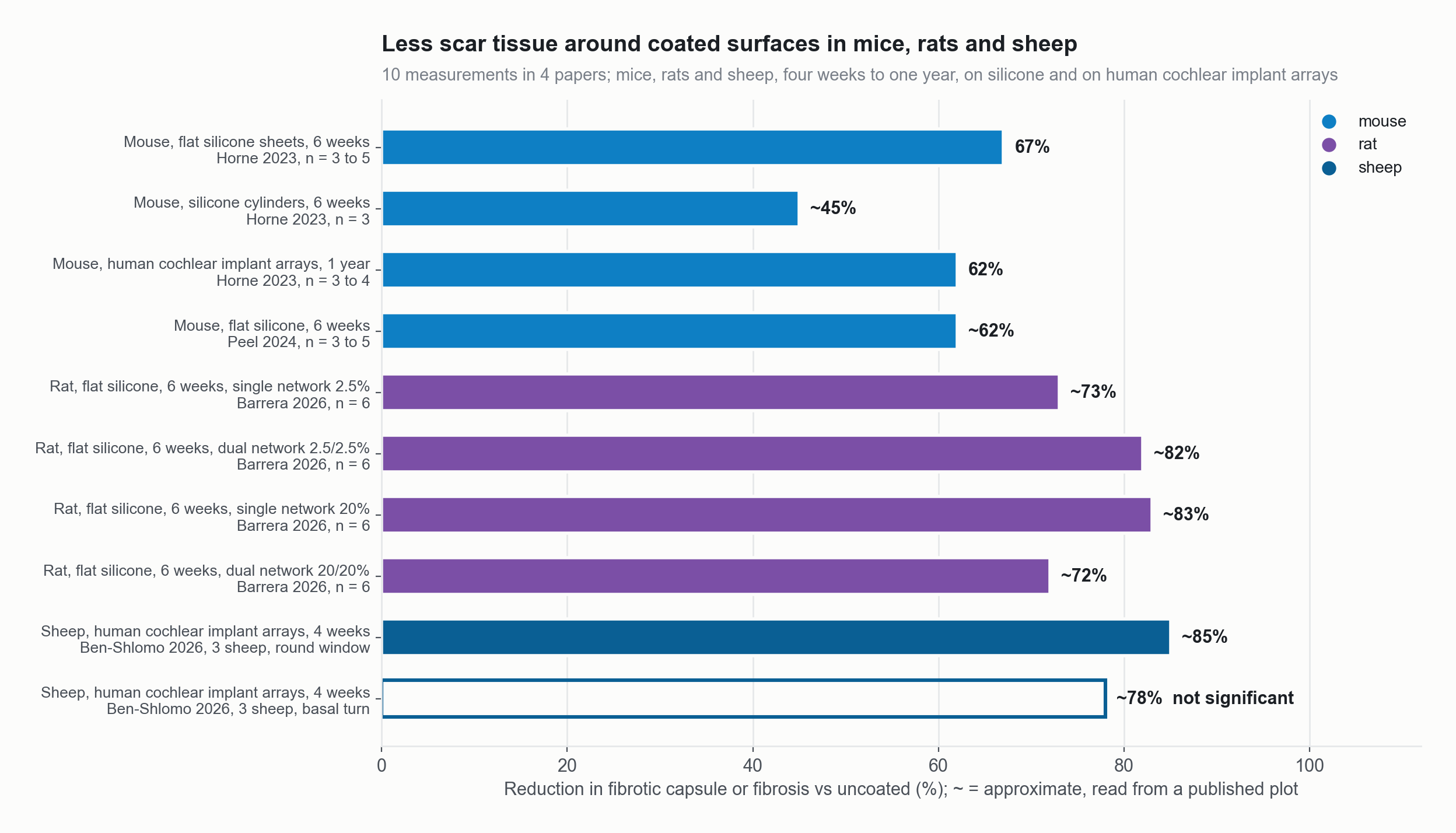
Less scar tissue around coated surfaces in mice, rats and sheep: percent reduction in fibrotic capsule or fibrosis, measurement by measurement. The hollow bar is not statistically significant.
Source: Horne R, et al. Acta Biomaterialia 2023;166:212-223 (Figs 5, 6G, 7I; flat-sheet and one-year values from the text, cylinder value approximate, read from the published figure); Peel A, et al. ACS Applied Bio Materials 2024;7:3124-3135 (Fig 3, values approximate, read from the published figure; text states over 60 percent); Barrera G, et al. ACS Applied Polymer Materials 2026;8(18):16328-16338, doi:10.1021/acsapm.6c02510 (Fig 7F, four coated groups, rats, 6 weeks, means read from the published plot; p < 0.0001 each versus uncoated); Ben-Shlomo N, et al. Hearing Research 2026;474:109606 (Fig 6G round window, p = 0.0101; Fig 5G basal turn, not significant; pooled values approximate, read from the published figure).
Friction. Friction against tissue, steel and ceramic was more than 90 percent lower on coated silicone (Bennion 2021).
Why it drops in
The coating is drug-free, so there is no antimicrobial agent and no combination product. Sterilization is validated on your cycle during joint development.
How to start
Send a few PEEK parts or sheaths, whatever surface finish you use, and we return them coated, with matched controls and bond data. Start a feasibility round
References (14)
- Shen N, Cheng E, Whitley JW, et al. Photograftable zwitterionic coatings prevent Staphylococcus aureus and Staphylococcus epidermidis adhesion to PDMS surfaces. ACS Appl Bio Mater. 2021;4(2):1283-1293.
- Horne R, Ben-Shlomo N, Jensen M, et al. Reducing the foreign body response on human cochlear implants and their materials in vivo with photografted zwitterionic hydrogel coatings. Acta Biomater. 2023;166:212-223.
- Bennion DM, Horne R, Peel A, et al. Zwitterionic photografted coatings of cochlear implant biomaterials reduce friction and insertion forces. Otol Neurotol. 2021;42(10):1476-1483.
- Leigh BL, Cheng E, Xu L, Derk A, Hansen MR, Guymon CA. Antifouling photograftable zwitterionic coatings on PDMS substrates. Langmuir. 2019;35(4):1100-1110.
- Bozic KJ, Kurtz SM, Lau E, et al. The epidemiology of revision total knee arthroplasty in the United States. Clin Orthop Relat Res. 2010;468(1):45-51.
- Bozic KJ, Kurtz SM, Lau E, Ong K, Vail TP, Berry DJ. The epidemiology of revision total hip arthroplasty in the United States. J Bone Joint Surg Am. 2009;91(1):128-133.
- Yao JJ, Hevesi M, Visscher SL, et al. Direct inpatient medical costs of operative treatment of periprosthetic hip and knee infections are twofold higher than those of aseptic revisions. J Bone Joint Surg Am. 2021;103(4):312-318.
- Tande AJ, Patel R. Prosthetic joint infection. Clin Microbiol Rev. 2014;27(2):302-345.
- Costerton JW, Stewart PS, Greenberg EP. Bacterial biofilms: a common cause of persistent infections. Science. 1999;284(5418):1318-1322.
- Walsh WR, Bertollo N, Christou C, Schaffner D, Mobbs RJ. Plasma-sprayed titanium coating to polyetheretherketone improves the bone-implant interface. Spine J. 2015;15(5):1041-1049.
- Sarfraz S, Mantynen PH, Laurila M, et al. Comparison of titanium and PEEK medical plastic implant materials for their bacterial biofilm formation properties. Polymers (Basel). 2022;14(18):3862.
- Punchak M, Chung LK, Lagman C, et al. Outcomes following polyetheretherketone (PEEK) cranioplasty: systematic review and meta-analysis. J Clin Neurosci. 2017;41:30-35.
- Leta TH, Lie SA, Fenstad AM, et al. Periprosthetic joint infection after total knee arthroplasty with or without antibiotic bone cement. JAMA Netw Open. 2024;7(5):e2412898.
- FDA. Intravascular Catheters, Wires, and Delivery Systems with Lubricious Coatings: Labeling Considerations. Guidance for Industry and FDA Staff. October 10, 2019.