
Application
GI stents
ZwiGuard™ is a drug-free coating tested on silicone for mucus flow, protein and bacterial adhesion and friction.
- Devices
- Covered biliary, esophageal, duodenal and colonic stents; plastic biliary stents; feeding tubes
- Substrates
- silicone (published); PVC, PEEK, parylene-C and polyurethane (ZwiCoat internal tests); PTFE, FEP, nitinol and others in the feasibility round
- Thickness
- tunable, from a few micrometres to 100 micrometres or more (ZwiCoat process range); about 7 micrometres in the published silicone work (Leigh 2019)
- Sterilization
- validated on your cycle during joint development
- Regulatory path
- Class II, 510(k): esophageal (ESW), duodenal (MUM), colonic (MQR), biliary (FGE); Pre-Submission recommended
- Evidence
- mucus-flow bench model; in vitro; rats, 21 days; mice, one year under the skin
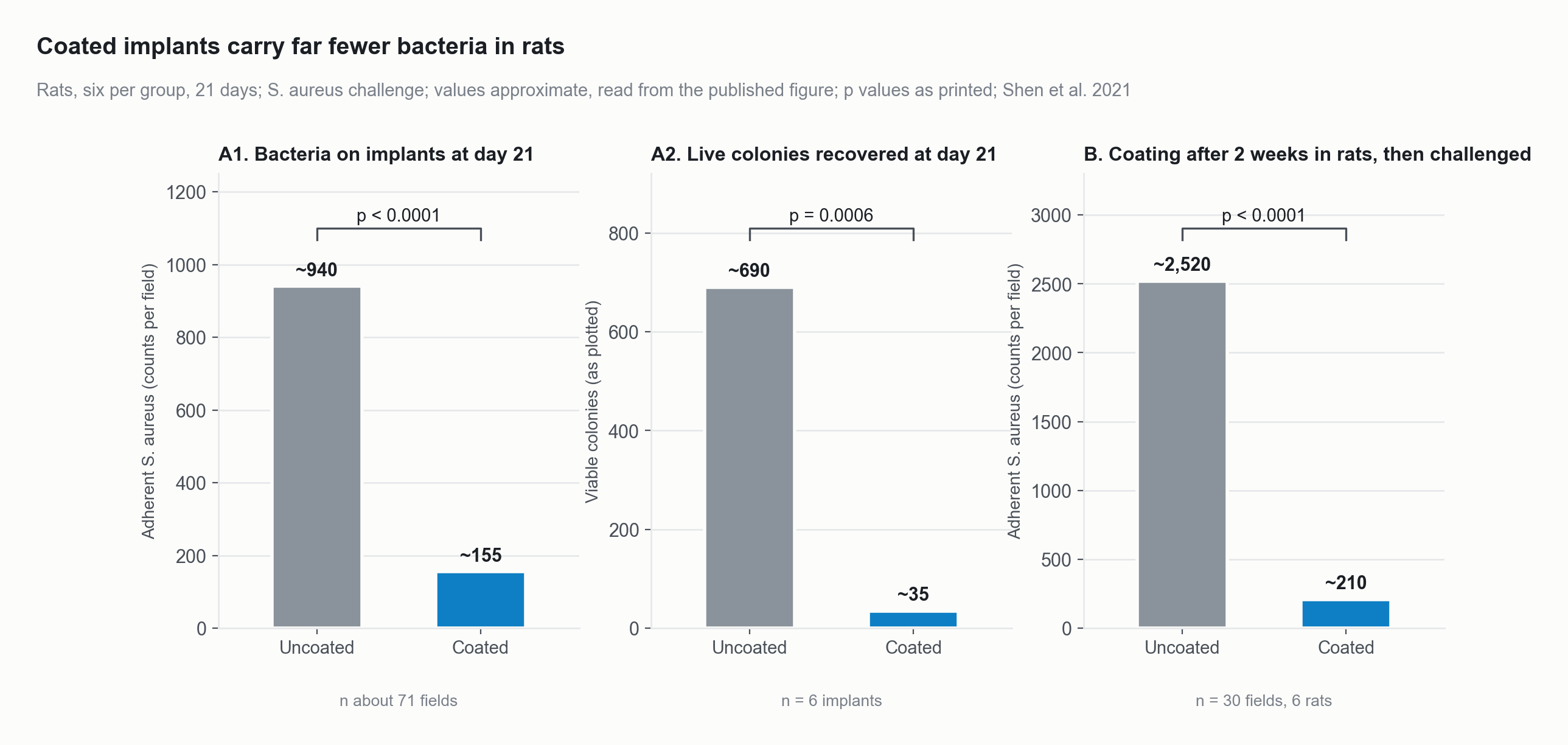
In rats challenged with S. aureus, coated silicone implants carried far fewer bacteria and live colonies at day 21, and a coating kept in a rat for two weeks still resisted a fresh S. aureus challenge.
Source: Shen N, Cheng E, Whitley JW, Horne RR, Leigh B, Xu L, Jones BD, Guymon CA, Hansen MR. Photograftable zwitterionic coatings prevent Staphylococcus aureus and Staphylococcus epidermidis adhesion to PDMS surfaces. ACS Applied Bio Materials 2021;4(2):1283-1293, Figs 7C, 7D and 8 (values approximate, read from the published figure; p values as printed). doi:10.1021/acsabm.0c01147
The problem
On plastic biliary stents, a film of host protein covers the inner surface and promotes bacterial adhesion (Donelli 2007). Covered metal stents trade one failure for another. In 12 studies of 2,358 patients, covered biliary metal stents had more sludge (odds ratio 3.25) and more migration (odds ratio 7.92) than uncovered ones (Yamashita 2022). In the esophagus, 29 percent of 216 patients had stent-related recurrent dysphagia, mostly from tumor overgrowth, migration or food bolus (Homs 2004).
Coated plastic stents have been tried. In three randomized trials, hydrophilic-coated or Teflon plastic stents did not extend patency over polyethylene (Costamagna 2000; van Berkel 1998; van Berkel 2003). A 2007 review judged coated and antimicrobial stents not yet clinically relevant enough to replace conventional ones (Donelli 2007).
What ZwiGuard does here
Every result below is from a published study on silicone, or from a bench model. No stent has been coated and tested in a published ZwiGuard study.
Bacteria, in rats. The chart above shows it. In rats challenged with S. aureus, coated implants carried about 155 bacteria per field at day 21, against about 940 uncoated (p < 0.0001). On coated silicone in vitro, S. aureus adhesion fell about 97 percent and S. epidermidis adhesion about 93 percent (Shen 2021). Fibrinogen adsorption fell by more than 90 percent (Leigh 2019).
Mucus flow. On coated silicone sheets, saline started to flow at about 0 degrees of tilt against 45 uncoated. In a 2.6 millimetre tube, flow started at 31 degrees against 48 (p = 0.0017). Dried mucus plugs cleared in a median 22.5 minutes against 30 (p = 0.024). The mucus was a non-human model, and the authors call the plug result modest and preliminary. The effect fades in narrower tubes: in 1.0 millimetre tubes the difference was 11 degrees. (Horne 2025.)
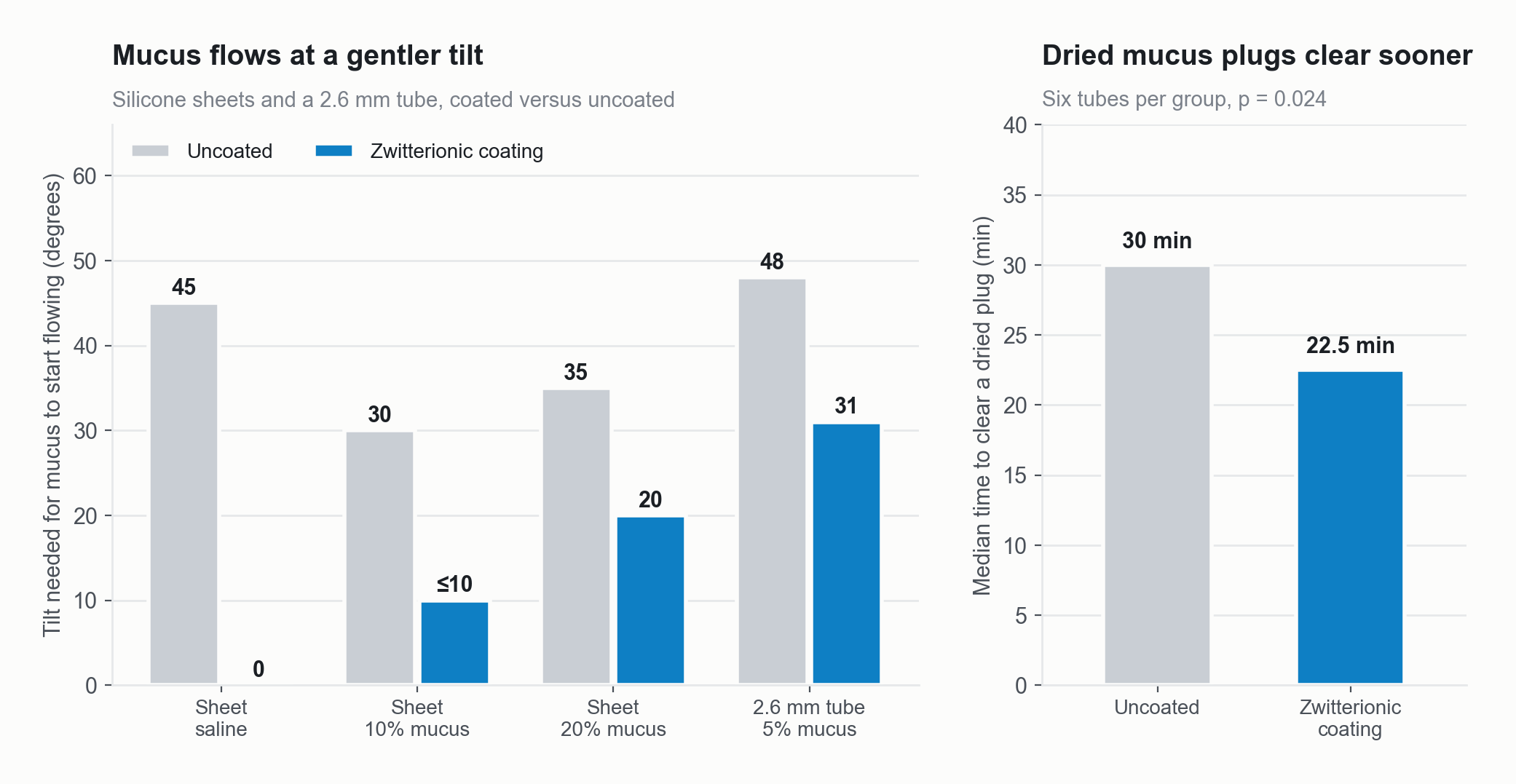
Zwitterionic grafted films let mucus flow at a gentler tilt on sheets and in a 2.6 mm tube, and cleared dried mucus plugs sooner.
Source: Horne R, Escudero C, Ellerman M, Guymon CA, Hansen M. Enhancing mucus flow and clearance by grafting zwitterionic hydrogel films to luminal surfaces. Laryngoscope Investig Otolaryngol 2025;10(2):e70118. doi:10.1002/lio2.70118
Durability and friction. Antifouling was unchanged after six months in mice, and the film was intact at one year (Horne 2023). Friction against tissue, steel and ceramic was more than 90 percent lower (Bennion 2021). That is a reason to test delivery. It is not a patency result.
Why it drops in
One coating step goes onto existing coverings and plastic stents. The film is drug-free, so there is no antimicrobial agent to manage. In ZwiCoat’s own tests on silicone coupons, it was intact after seven of eight sterilization cycles; wet e-beam did not pass. Your cycle is validated during joint development.
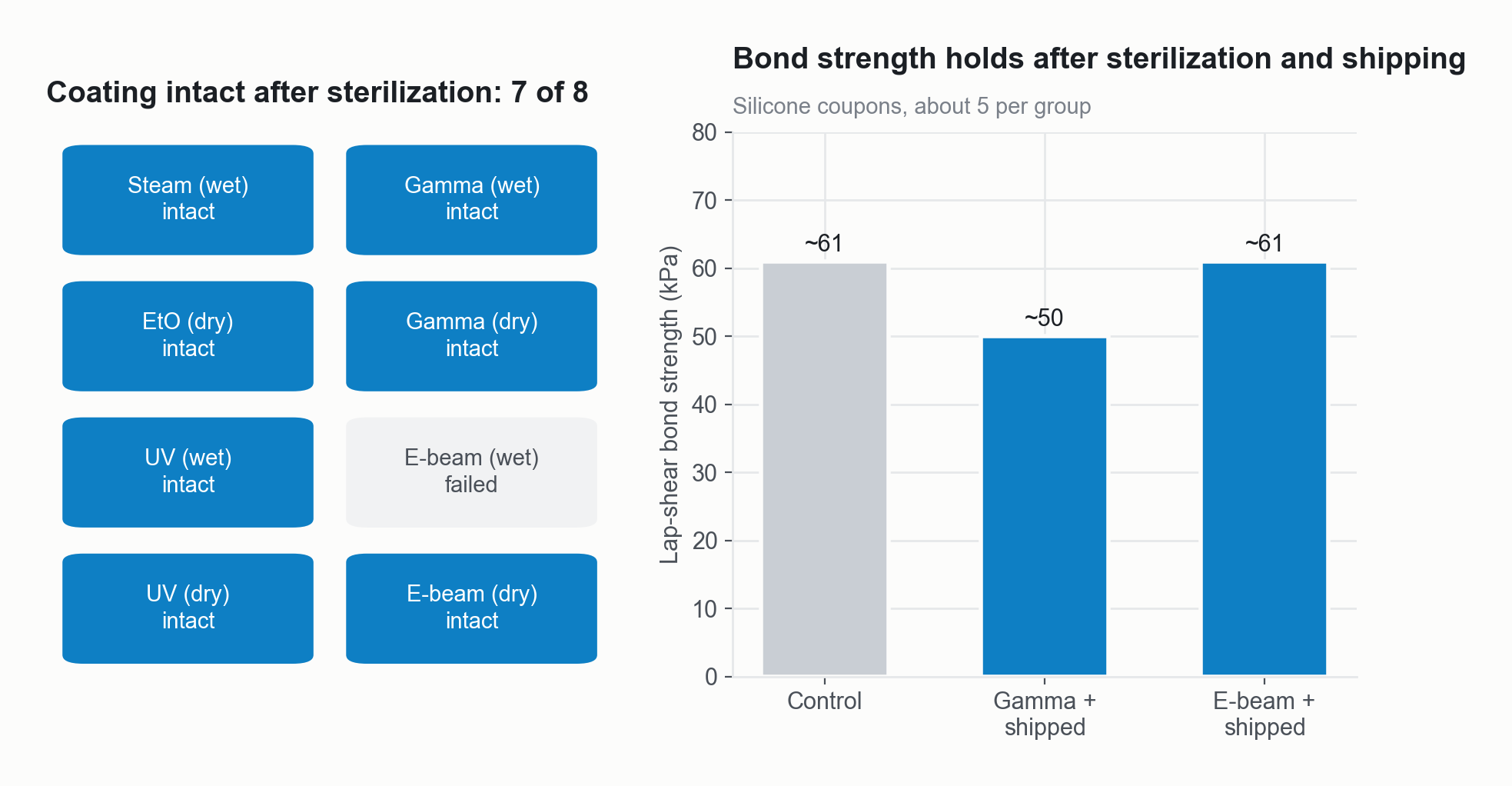
Sterilization compatibility and bond strength after sterilization plus shipping. The coating was intact after seven of eight sterilization cycles; wet e-beam failed.
Source: ZwiCoat CIVCO sterilization study, 2025 (Kyle Ruby). Internal data; silicone coupons, about 5 per group.
Silicone is the published substrate. The matrix below shows where ZwiCoat also has internal data. PTFE, FEP and nitinol, and crimping and expansion of a finished stent, are feasibility-round questions.
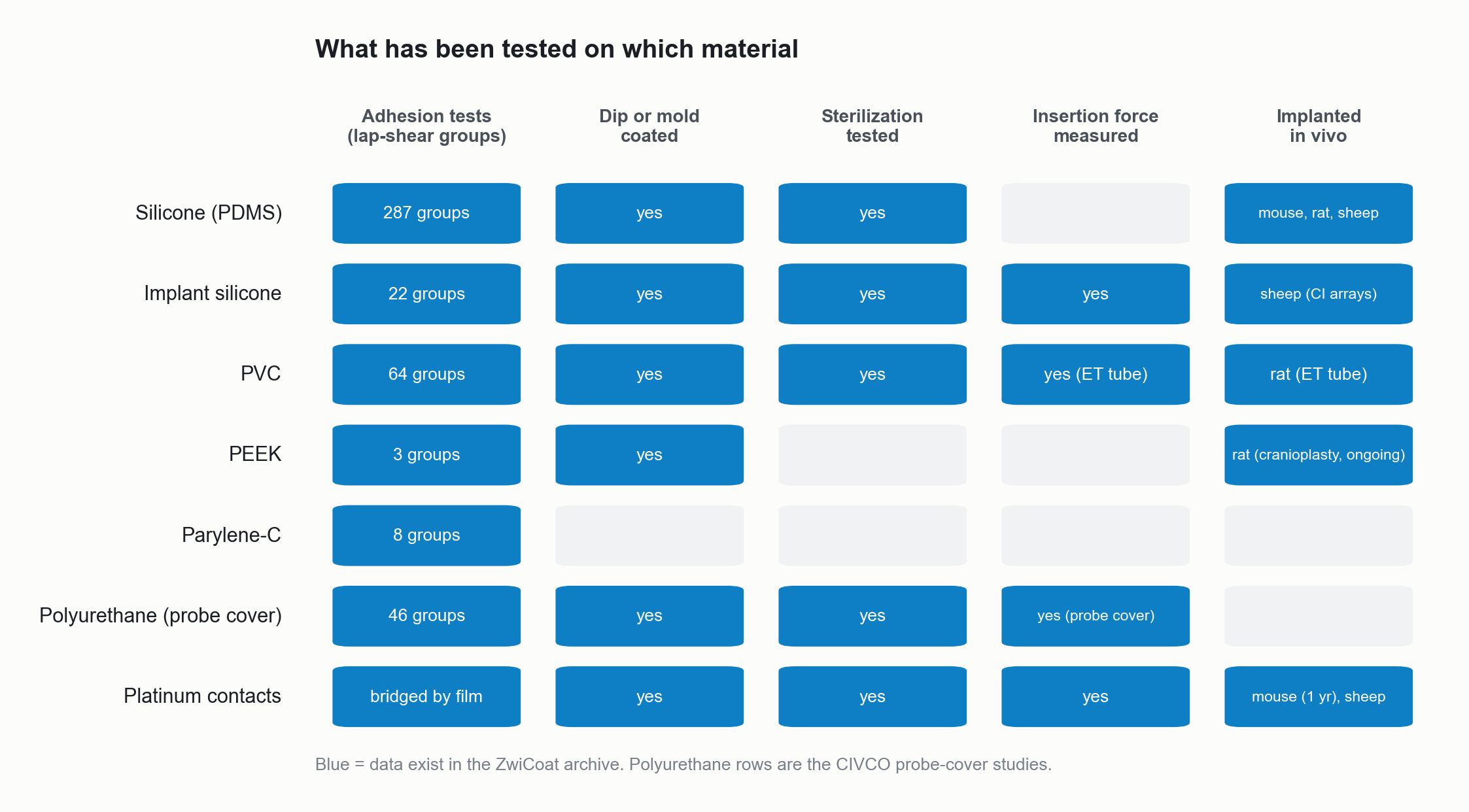
Evidence matrix: substrates versus the kinds of test on record. Blue means data exist in the ZwiCoat archive; polyurethane is the CIVCO probe cover.
Source: ZwiCoat Lap-shear Master database; archived experiment reports; published studies. Adhesion on silicone is published (Leigh 2019); the other cells are internal ZwiCoat tests.
How to start
Pick one stent line and send a few; we return them coated, with matched uncoated controls and our friction and adhesion data. Start a feasibility round
References (12)
- Donelli G, Guaglianone E, Di Rosa R, Fiocca F, Basoli A. Plastic biliary stent occlusion: factors involved and possible preventive approaches. Clin Med Res. 2007;5(1):53-60.
- Yamashita Y, Tachikawa A, Shimokawa T, et al. Covered versus uncovered metal stent for endoscopic drainage of a malignant distal biliary obstruction: meta-analysis. Dig Endosc. 2022;34(5):938-951.
- Homs MY, Steyerberg EW, Kuipers EJ, et al. Causes and treatment of recurrent dysphagia after self-expanding metal stent placement for palliation of esophageal carcinoma. Endoscopy. 2004;36(10):880-886.
- Costamagna G, Mutignani M, Rotondano G, et al. Hydrophilic hydromer-coated polyurethane stents versus uncoated stents in malignant biliary obstruction: a randomized trial. Gastrointest Endosc. 2000;51(1):8-11.
- van Berkel AM, Bruno MJ, Bergman JJ, van Deventer SJ, Tytgat GN, Huibregtse K. A prospective randomized study of hydrophilic polymer-coated polyurethane versus polyethylene stents in distal malignant biliary obstruction. Endoscopy. 2003;35(6):478-482.
- van Berkel AM, Boland C, Redekop WK, et al. A prospective randomized trial of Teflon versus polyethylene stents for distal malignant biliary obstruction. Endoscopy. 1998;30(8):681-686.
- Horne R, Escudero C, Ellerman M, Guymon CA, Hansen M. Enhancing mucus flow and clearance by grafting zwitterionic hydrogel films to luminal surfaces. Laryngoscope Investig Otolaryngol. 2025;10(2):e70118.
- Leigh BL, Cheng E, Xu L, Derk A, Hansen MR, Guymon CA. Antifouling photograftable zwitterionic coatings on PDMS substrates. Langmuir. 2019;35(4):1100-1110.
- Shen N, Cheng E, Whitley JW, et al. Photograftable zwitterionic coatings prevent Staphylococcus aureus and Staphylococcus epidermidis adhesion to PDMS surfaces. ACS Appl Bio Mater. 2021;4(2):1283-1293.
- Horne R, Ben-Shlomo N, Jensen M, et al. Reducing the foreign body response on human cochlear implants and their materials in vivo with photografted zwitterionic hydrogel coatings. Acta Biomater. 2023;166:212-223.
- Bennion DM, Horne R, Peel A, et al. Zwitterionic photografted coatings of cochlear implant biomaterials reduce friction and insertion forces. Otol Neurotol. 2021;42(10):1476-1483.
- FDA Product Classification database, product codes ESW, MQR, MUM and FGE; 21 CFR 878.3610 and 21 CFR 876.5010. accessdata.fda.gov.