
Application
Tissue expanders and breast implants
ZwiGuard™ is a drug-free coating for finished silicone shells, tested for scar capsule thickness in mice and for bacterial adhesion in the laboratory and in rats.
- Devices
- Tissue expanders, smooth silicone breast implants
- Substrates
- silicone (published); PVC, PEEK, parylene-C and polyurethane (ZwiCoat internal tests); others in the feasibility round
- Thickness
- tunable, from a few micrometres to 100 micrometres or more (ZwiCoat process range); about 7 micrometres in the published silicone work (Leigh 2019)
- Sterilization
- validated on your cycle during joint development
- Regulatory path
- 510(k) for expanders; PMA supplement for implants; a Pre-Submission confirms both
- Evidence
- mice, six weeks to one year; rats, 21 days; laboratory
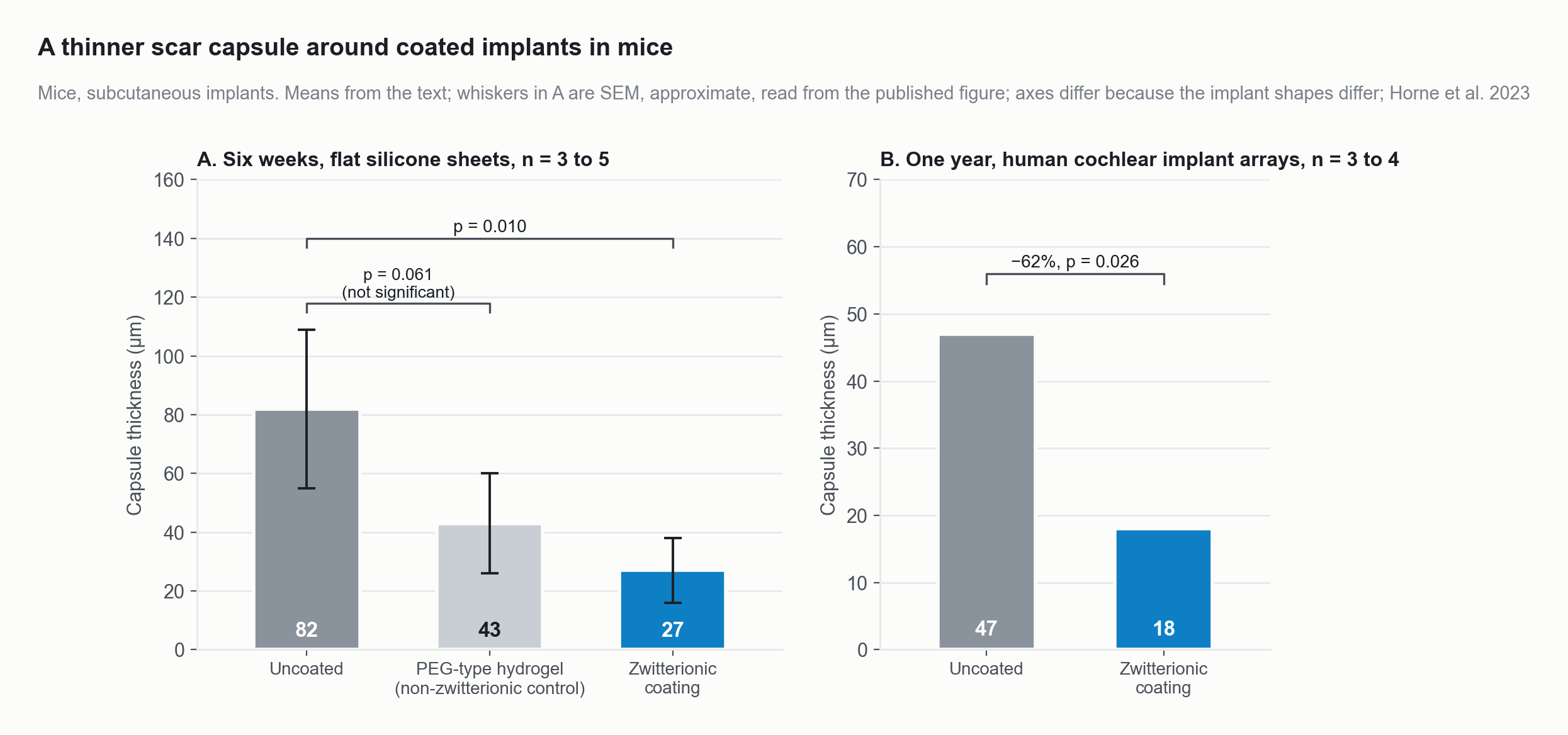
In mice, scar capsules were 67 percent thinner around zwitterionic-coated silicone at six weeks and 62 percent thinner around coated human cochlear implant arrays at one year; a non-zwitterionic hydrogel control did not differ significantly from uncoated.
Source: Horne R, Ben-Shlomo N, Jensen M, et al. Reducing the foreign body response on human cochlear implants and their materials in vivo with photografted zwitterionic hydrogel coatings. Acta Biomaterialia 2023;166:212-223, Figs 5D and 7I (means and p values from the text; SEM whiskers approximate, read from the published figure). doi:10.1016/j.actbio.2023.05.011
The problem
Every silicone implant is walled off in scar. Proteins stick to the silicone first, and the body builds a capsule around the device. That means firmness, distortion and discomfort. At the severe end it tightens into capsular contracture, the most common long-term complication of implant surgery. Reported rates run from about 2 to 39 percent, depending on follow-up, radiation, surgical plane and implant surface (Headon 2015; Aesthetic Surgery Journal Open Forum 2025).
Textured implants were once used to lower contracture. In 2019 the FDA requested a recall of BIOCELL textured implants and expanders, and textured use fell.
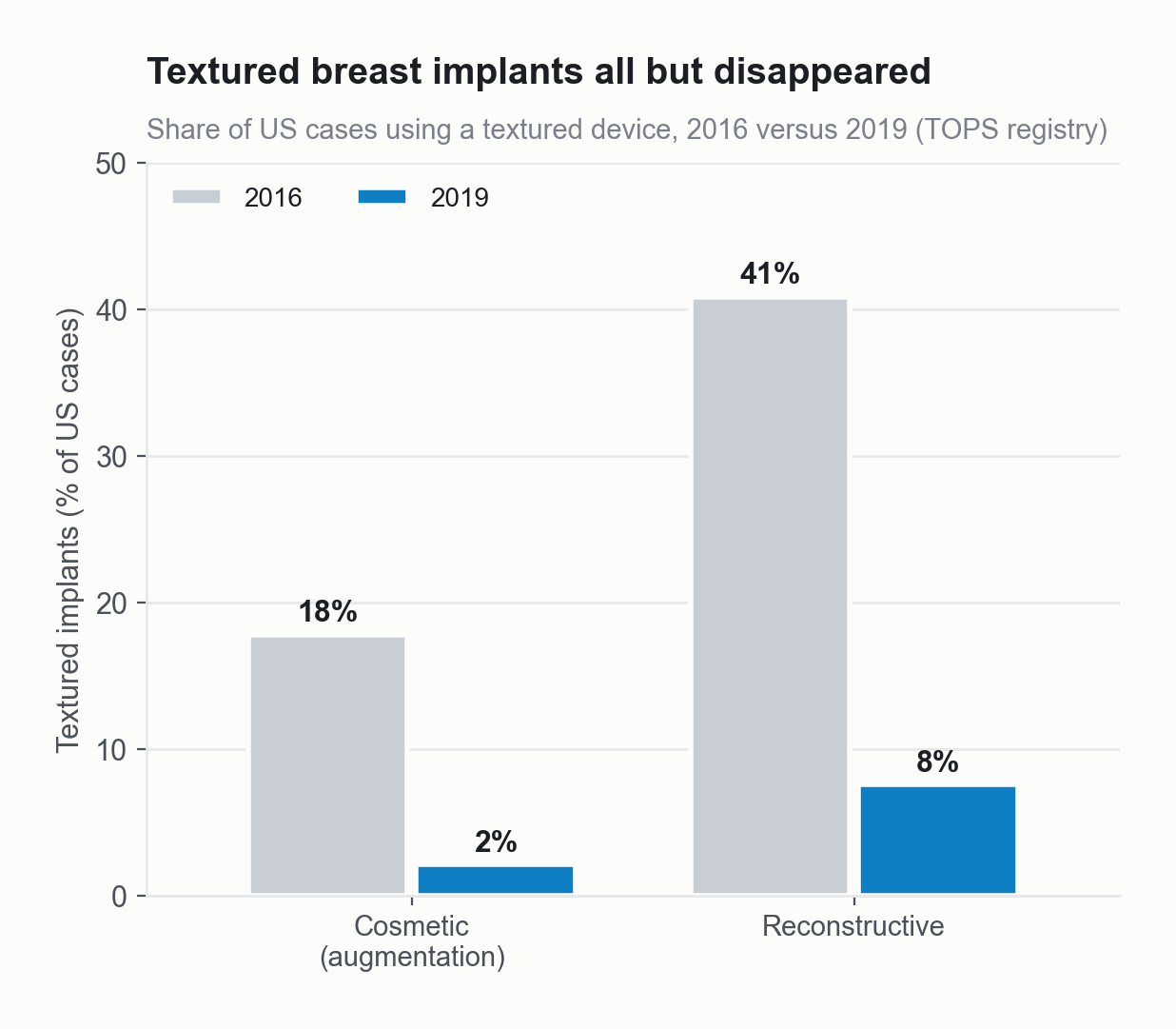
Textured breast implant use fell from 18 to 2 percent of cosmetic cases and from 41 to 8 percent of reconstructive cases between 2016 and 2019.
Source: Matros E, Shamsunder MG, Rubenstein RN, et al. Textured and smooth implant use reported in the TOPS database: epidemiologic implications for BIA-ALCL. Plast Reconstr Surg Glob Open 2021;9(3):e3499. doi:10.1097/GOX.0000000000003499
Smooth implants are now the default. They carry roughly three times the contracture rate of textured ones (Zhai 2022). For expanders, fibrosis restricts filling, and infection is a leading cause of early removal (Huang 2015; Churchill 2025). Antibiotic irrigation, no-touch technique and dermal matrix wraps act downstream. None of them changes the silicone surface.
What ZwiGuard does here
Every result below is a laboratory, mouse, rat or sheep result from a published study. No coated implant or expander has been placed in a person.
Scar capsule, in mice at six weeks. The chart above shows it. Around coated silicone sheets the capsule was 27 micrometres, against 82 around uncoated sheets (p = 0.010). A non-zwitterionic PEG-type hydrogel gave 43, not significantly different from uncoated. (Horne 2023, Acta Biomaterialia.) Across ten published measurements in mice, rats and sheep, the reduction ranged from about 45 to about 85 percent.
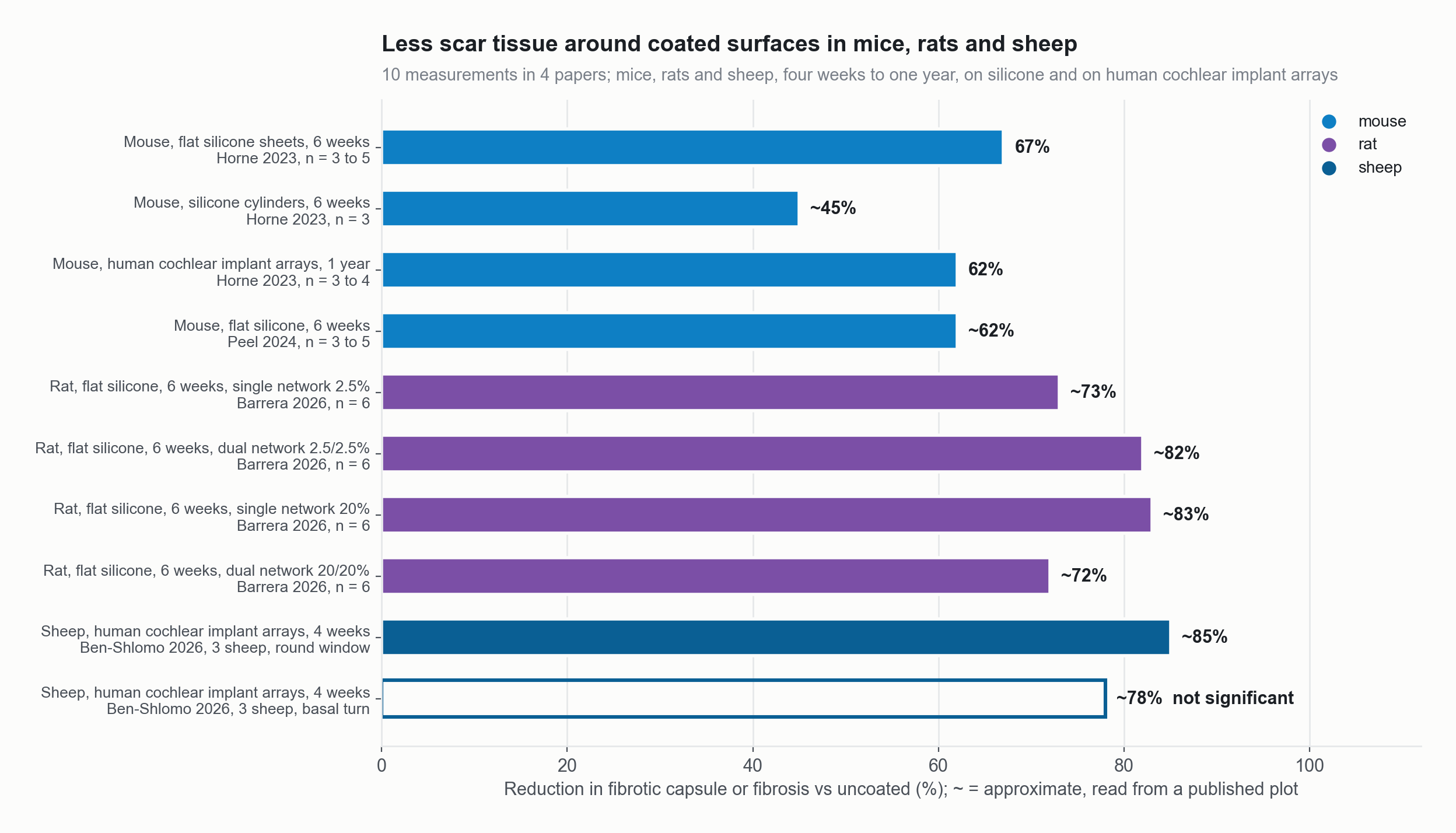
Less scar tissue around coated surfaces in mice, rats and sheep: percent reduction in fibrotic capsule or fibrosis, measurement by measurement. The hollow bar is not statistically significant.
Source: Horne R, et al. Acta Biomaterialia 2023;166:212-223 (Figs 5, 6G, 7I; flat-sheet and one-year values from the text, cylinder value approximate, read from the published figure); Peel A, et al. ACS Applied Bio Materials 2024;7:3124-3135 (Fig 3, values approximate, read from the published figure; text states over 60 percent); Barrera G, et al. ACS Applied Polymer Materials 2026;8(18):16328-16338, doi:10.1021/acsapm.6c02510 (Fig 7F, four coated groups, rats, 6 weeks, means read from the published plot; p < 0.0001 each versus uncoated); Ben-Shlomo N, et al. Hearing Research 2026;474:109606 (Fig 6G round window, p = 0.0101; Fig 5G basal turn, not significant; pooled values approximate, read from the published figure).
Durability and bacteria. After six months under the skin of mice, the fibroblast-repelling effect was unchanged, and the film was intact at one year (Horne 2023). In rats challenged with S. aureus, implants carried about 940 bacteria per field uncoated and about 155 coated at day 21 (p < 0.0001). These are laboratory and rat results, not clinical results. (Shen 2021.)
Why it drops in
ZwiGuard is a coating step on a finished silicone shell. It needs no new mold and no new geometry. One UV step grafts and crosslinks the film, about 7 micrometres thick in the published silicone work. It failed inside the gel before the silicone interface let go (Leigh 2019).
Expanders get hit and stretched. In an internal pendulum impact test, a coated expander showed no visible damage to the coating. See the durability record.
Whether the film stretches with an inflated expander is measured in the feasibility round on your parts. So is adhesion on your silicone grade. In ZwiCoat’s own tests on silicone coupons, the coating survived seven of eight sterilization cycles; wet e-beam did not.
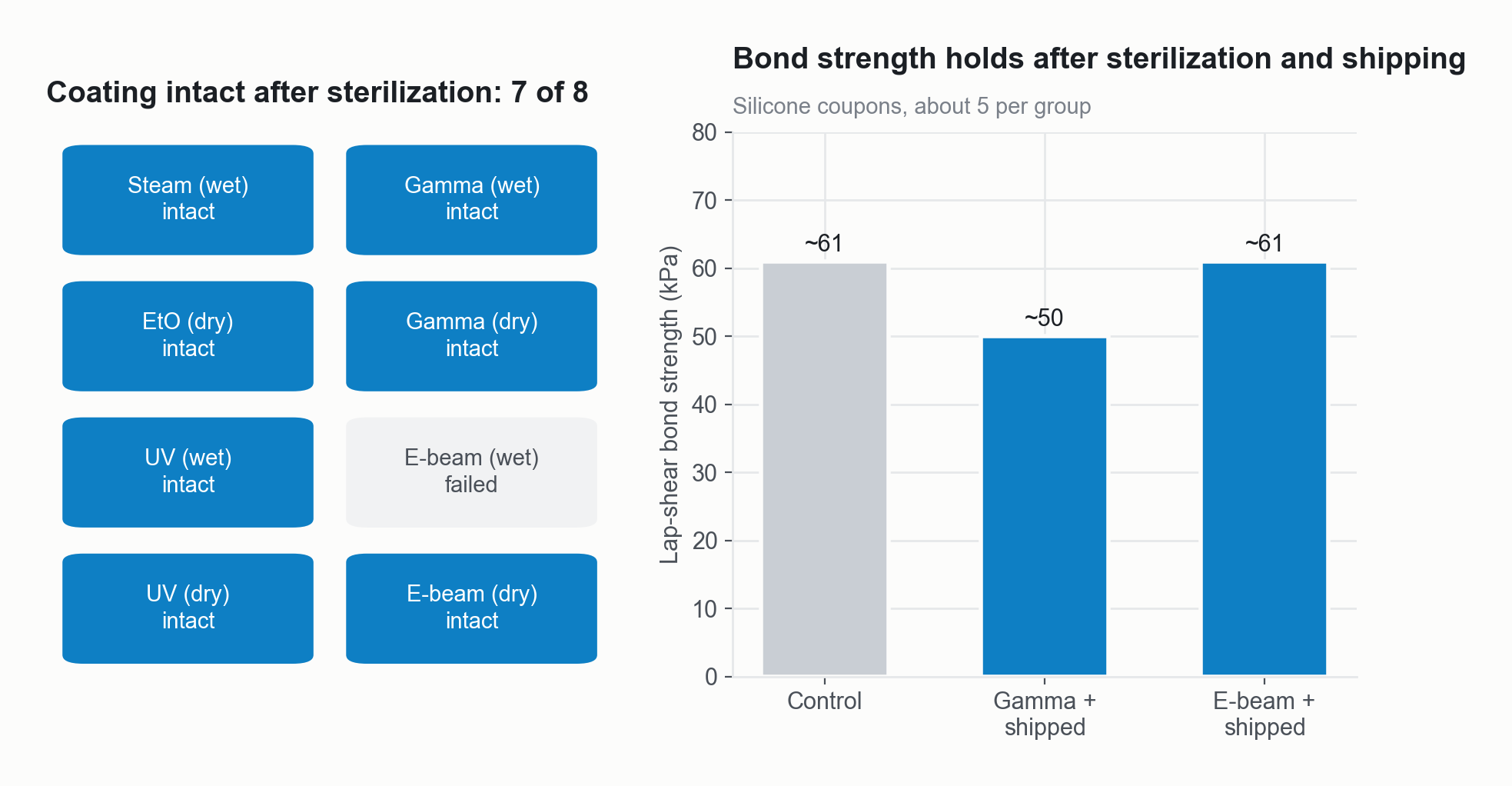
Sterilization compatibility and bond strength after sterilization plus shipping. The coating was intact after seven of eight sterilization cycles; wet e-beam failed.
Source: ZwiCoat CIVCO sterilization study, 2025 (Kyle Ruby). Internal data; silicone coupons, about 5 per group.
How to start
Expanders come first, through a 510(k), and implants follow through a PMA supplement; send shells or expanders and we return them coated, with matched controls. Start a feasibility round
References (11)
- Horne R, Ben-Shlomo N, Jensen M, et al. Reducing the foreign body response on human cochlear implants and their materials in vivo with photografted zwitterionic hydrogel coatings. Acta Biomater. 2023;166:212-223.
- Peel A, Bennion D, Horne R, Hansen MR, Guymon CA. Photografted zwitterionic hydrogel coating durability for reduced foreign body response to cochlear implants. ACS Appl Bio Mater. 2024;7(5):3124-3135.
- Shen N, Cheng E, Whitley JW, et al. Photograftable zwitterionic coatings prevent Staphylococcus aureus and Staphylococcus epidermidis adhesion to PDMS surfaces. ACS Appl Bio Mater. 2021;4(2):1283-1293.
- Leigh BL, Cheng E, Xu L, Derk A, Hansen MR, Guymon CA. Antifouling photograftable zwitterionic coatings on PDMS substrates. Langmuir. 2019;35(4):1100-1110.
- Headon H, Kasem A, Mokbel K. Capsular contracture after breast augmentation: an update for clinical practice. Arch Plast Surg. 2015;42(5):532-543.
- Capsular contracture after breast augmentation: a systematic review and meta-analysis. Aesthet Surg J Open Forum. 2025;7:ojaf003.
- US Food and Drug Administration. FDA requests Allergan voluntarily recall BIOCELL textured breast implants and tissue expanders due to BIA-ALCL risk. 2019.
- Matros E, Shamsunder MG, Rubenstein RN, et al. Textured and smooth implant use reported in the TOPS database: epidemiologic implications for BIA-ALCL. Plast Reconstr Surg Glob Open. 2021;9(3):e3499.
- Zhai P, Wu Y, Yang D. A systematic review and meta-analysis of capsular contracture rate after breast augmentation with textured and smooth breast prostheses. Gland Surg. 2022;11(1):166-174.
- Huang J, Yu N, Long X. Tissue expander complications predict permanent implant complications and failure of breast reconstruction. Ann Plast Surg. 2015;75(1):24-28.
- Churchill IF, Gallo L, Dunn E. Complications and burden of 2-stage tissue expander to implant-based reconstructive surgery: a single-center retrospective study. Plast Surg (Oakv). 2025.